
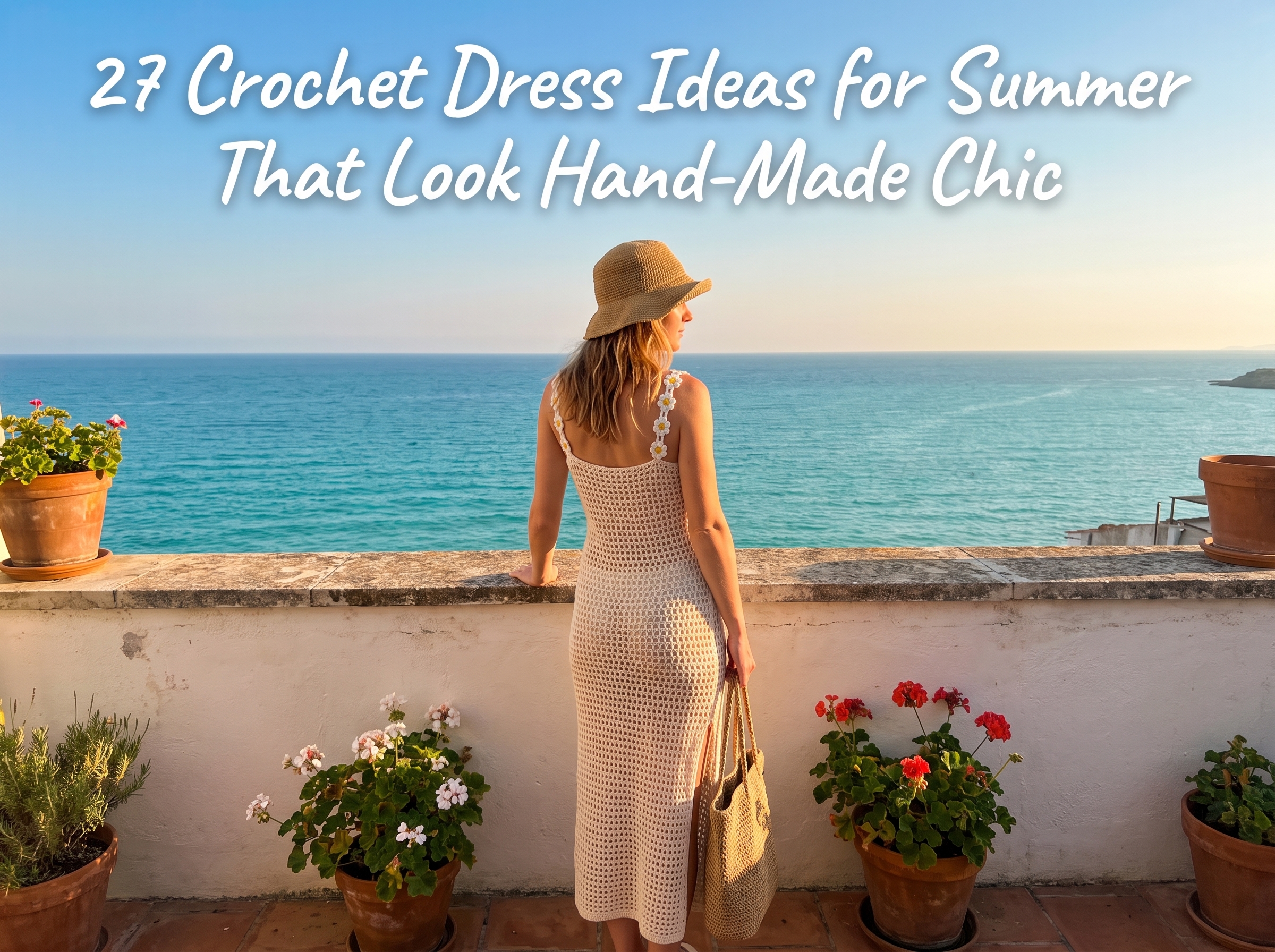
Most crochet dress patterns give you a granny square halter and a prayer. This list gives you a honeycomb stitch backless tie dress, a pineapple stitch midi with a side slit, and 25 other silhouettes that look like they came off a boutique rack — not a craft fair table.
These 27 crochet dress ideas for summer were built for three kinds of crocheters: the maker who wants a dress she will actually wear out, not just photograph and fold away; the intermediate crocheter ready to move past basic squares into real garment construction — shell stitch, filet lace, ripple stripes; and the gift-maker looking for a handmade dress idea that doesn’t announce “craft project” the moment someone sees it.
Every dress on this list names the exact stitch, the hook size, and a real yarn shade you can buy today — no vague “use any cotton yarn” instructions. Scroll through all 27. Idea #25 is the one our readers keep coming back to ask about.
1. Crochet Open-Back Shell Stitch Sundress with Scalloped Hem
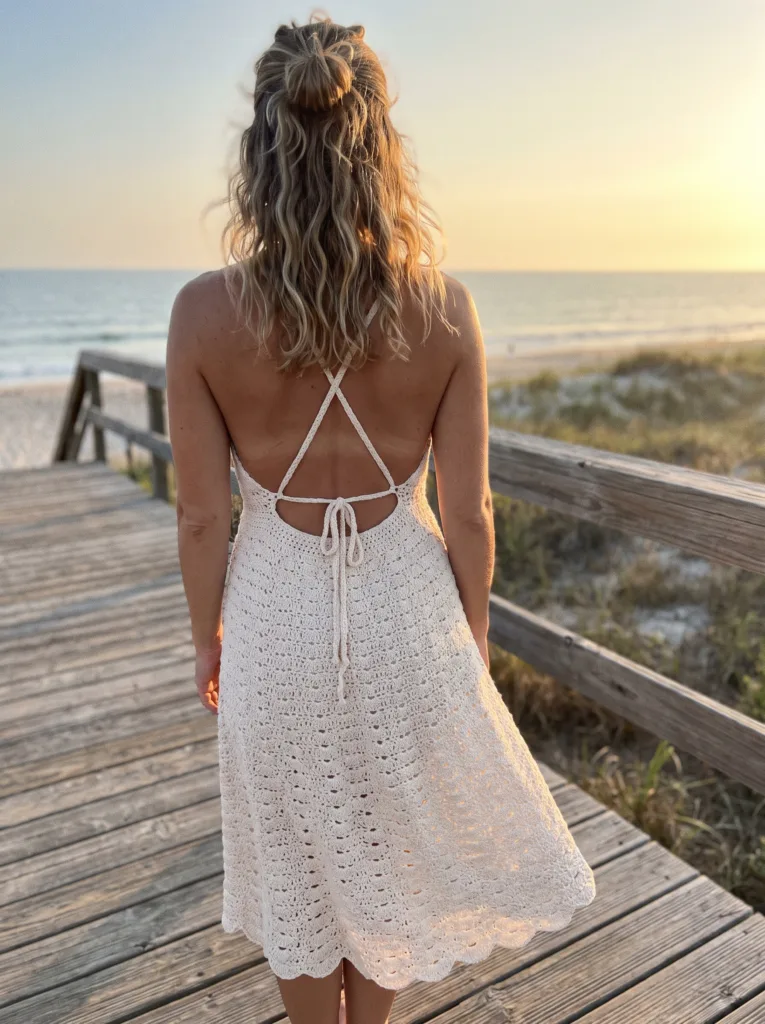
The open back is the entire reason to make this dress — it’s cut low enough to actually show your spine line, not just hint at it, and that’s rare in crochet sundress patterns.
The Body & Shell Stitch Construction
I worked the bodice and skirt in one continuous panel using basic shell stitch — 5 dc into one stitch, skip 2, repeat — with a 4mm hook and DK weight cotton. Shell stitch gives you that soft, scalloped texture throughout the dress without needing a separate edging pattern later, since the shells naturally create movement in the fabric as you wear it. I worked the bodice slightly tighter (dropping to a 3.5mm hook for 6 rows at the ribcage) so it holds shape without a lining.
The Open Back & Scalloped Hem
For the open back, I split the bodice into two straps at shoulder blade level and let them cross and tie at the lower back — this is the detail that makes the dress photograph so well from behind. The hem is simply the natural shell stitch edge left unworked on the final row, which is why it falls into that soft scalloped wave instead of a straight line.
Yarn Suggestions to Recreate This Sundress:
- Body: DK weight cotton in ivory — Scheepjes Catona Old Lace (130)
- Alternative shade: Lion Brand 24/7 Cotton in Linen
- Hook sizes: 4mm for body, 3.5mm for fitted ribcage rows
2. Crochet Lemon Motif Strap Mini Dress with Airy Mesh Panels
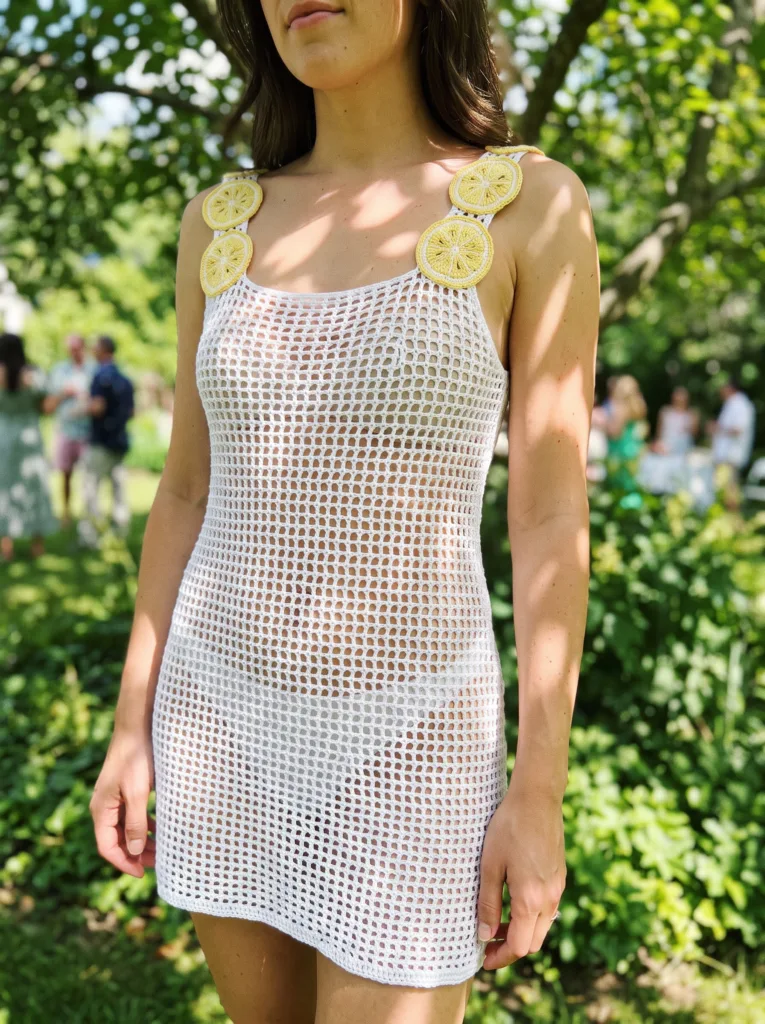
The lemon motifs on the straps are crocheted separately and sewn on — and that’s what keeps them crisp instead of stretched out of shape after a few wears.
The Mesh Body
I worked the main body of this mini dress in a simple filet mesh — chain 2, dc, repeat — using white 4-ply cotton and a 4mm hook, which keeps the fabric airy enough to see a hint of skin tone through it without being fully sheer. The mesh runs the full length of the dress with no waist shaping, so it skims rather than clings, which is exactly what you want on a humid summer day.
The Lemon Motif Straps
The lemon slices on each strap are crocheted flat as small circles — alternating rounds of butter yellow and white to mimic the lemon’s flesh and rind — then I sewed three motifs onto each strap with matching sewing thread before attaching the straps to the dress body. Working the motifs separately means they stay perfectly round and don’t distort the way an integrated motif would after repeated wear.
Yarn Suggestions to Recreate This Mini Dress:
- Body: 4-ply cotton in white — Paintbox Yarns Simply DK in Soft White
- Lemon motifs: 4-ply cotton in butter yellow — Scheepjes Catona Lemon (245)
- Hook sizes: 4mm for mesh body, 3mm for lemon motifs
3. Crochet Sleeveless Pineapple Stitch Midi Dress with Side Slit
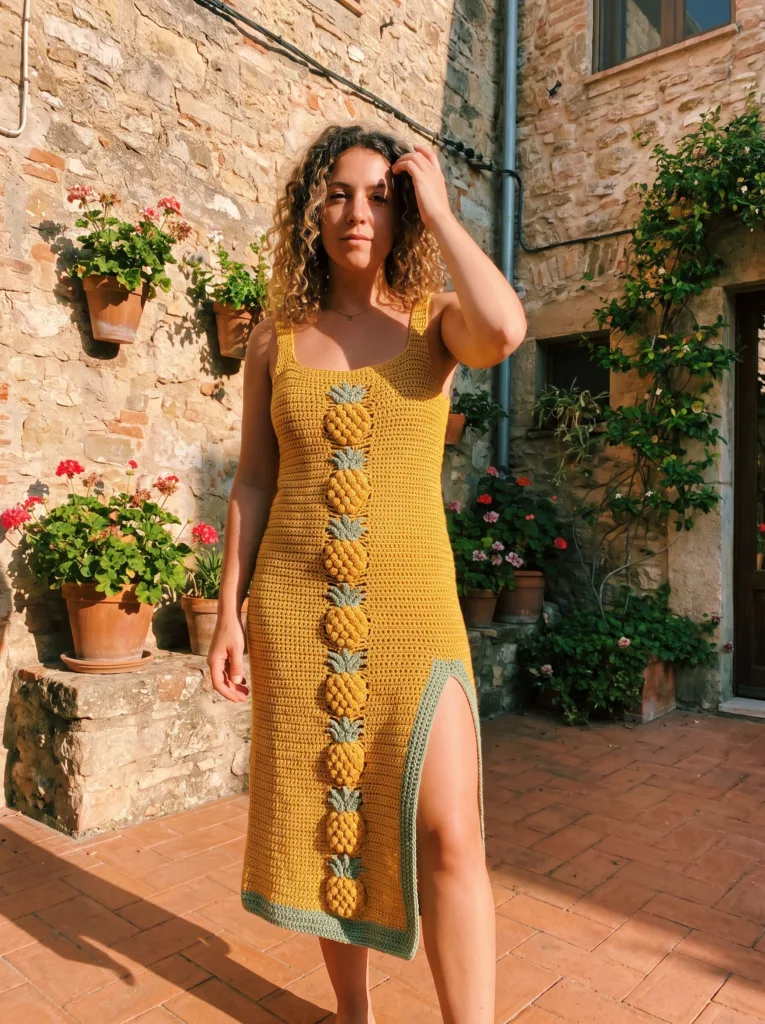
The pineapple stitch panels down the front aren’t decorative — they’re doing the actual shaping work that gives this midi dress its fitted-through-the-waist silhouette.
The Pineapple Stitch Panels
The front and back panels are worked entirely in pineapple stitch — the traditional layered cluster motif crocheted in vertical columns — using golden yellow DK cotton and a 3.5mm hook to keep the clusters dense and well-defined rather than loose and lacy. Pineapple stitch naturally tapers at the waist if you decrease one column on each side around row 18, which is exactly how this dress gets its fitted-through-the-middle shape without any separate waist shaping rows.
The Side Slit & Fit
The side slit starts at the natural hip point and is created simply by leaving the side seam unjoined for the final 12 rows on the right side only — no special stitch technique needed, just intentional construction. I added a single round of sage green sc along the slit edge and the hemline to stop the cotton from curling and to introduce a quiet color contrast against the golden yellow body.
Yarn Suggestions to Recreate This Midi Dress:
- Body: DK weight cotton in golden yellow — We Crochet Cotton Sprout in Honey
- Edging accent: DK cotton in sage green — Paintbox Yarns Simply DK in Sage Green
- Hook sizes: 3.5mm throughout, 3mm for the slit and hem edging
4. Crochet Butterfly Applique Square Neck Mini Dress
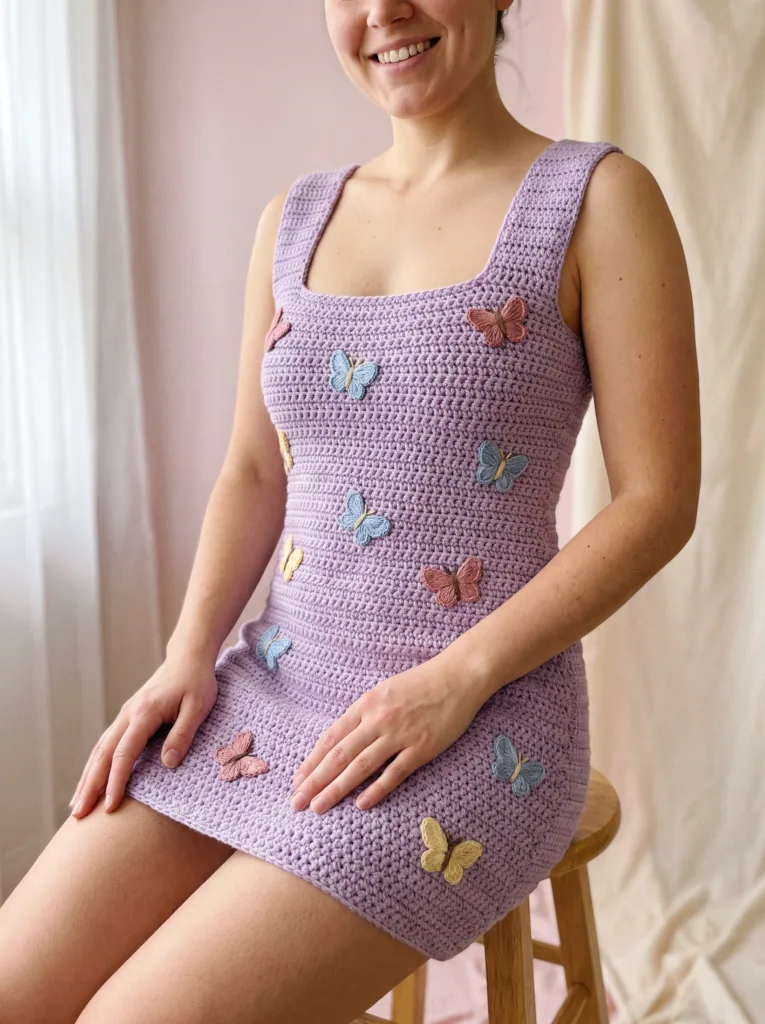
Every butterfly on this dress is a separate tiny motif — and that hand-placed, scattered arrangement is what keeps it from looking like a printed fabric pattern.
The Body & Square Neckline
The dress body is worked in simple double crochet using lavender 4-ply cotton and a 4mm hook, with the square neckline shaped by working the front and back panels separately up to the underarm, then joining only at the shoulders — this is what gives you that clean, structured square edge instead of a rounded scoop. I kept the stitch count consistent with no waist shaping for an easy, swingy mini silhouette.
The Butterfly Appliques
Each butterfly is crocheted as a flat two-wing motif using leftover scraps in dusty rose, sky blue, and butter yellow — about 4-5 rounds per wing pair, finished with a simple chain-stitch antennae detail. I scattered nine butterflies across the bodice and skirt at random angles before sewing them on individually with matching sewing thread, which is the detail that makes them look like they’ve genuinely landed on the fabric rather than printed onto it.
Yarn Suggestions to Recreate This Mini Dress:
- Body: 4-ply cotton in lavender — Scheepjes Catona Lavender (520)
- Butterfly scraps: small amounts in dusty rose, sky blue, butter yellow — any leftover 4-ply cotton works
- Hook sizes: 4mm for body, 2.5mm for butterfly motifs
5. Crochet Filet Lace Tank Dress with Geometric Pattern
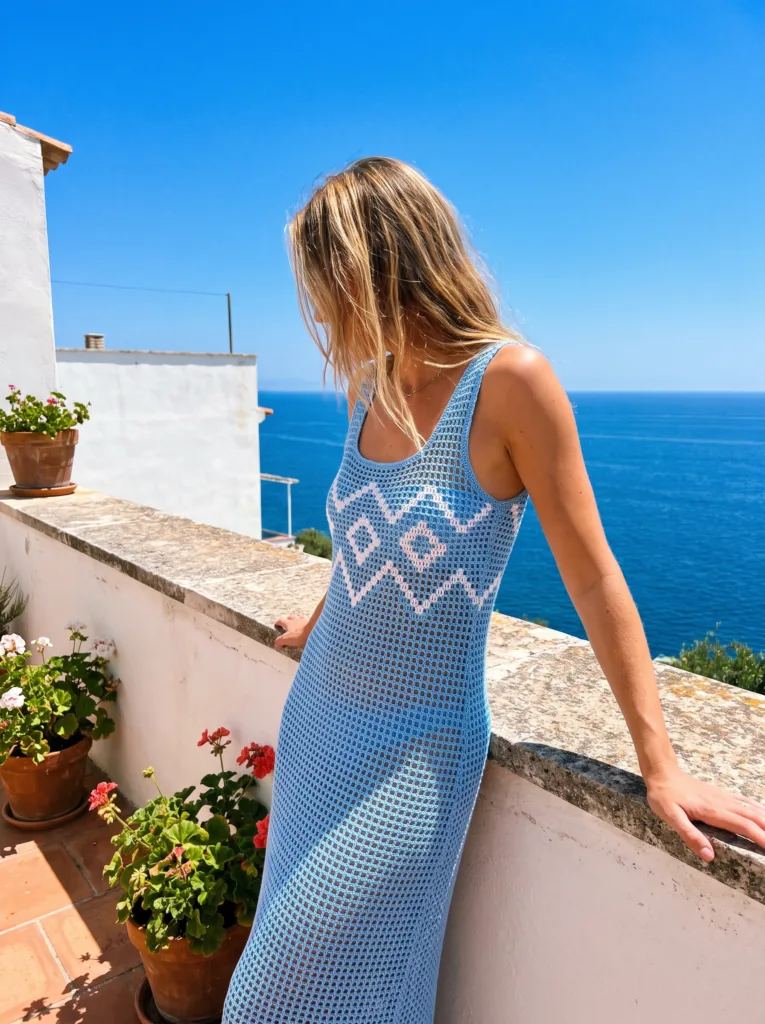
The geometric pattern across the front isn’t embroidered on afterward — it’s built directly into the filet mesh using a charted block-and-space technique.
The Filet Lace Base
I worked this tank dress in filet crochet — alternating blocks of 3 dc and open mesh spaces of ch-2 — using sky blue 4-ply cotton and a 3.5mm hook, which keeps the lace lightweight enough for genuinely hot days while still holding its shape on the body. Filet crochet is worked from a simple grid chart, so once you’ve charted your pattern you’re really just following a block-or-space decision row by row.
The Geometric Pattern
The diamond and chevron pattern across the bodice is created entirely by which grid squares are filled (block) versus left open (space) — I used white cotton for every third row to make the geometric shapes pop against the sky blue background rather than blending tonally. This contrast-row technique is the easiest way to make any filet pattern read clearly from a distance, which matters for a dress meant to be seen across a room.
Yarn Suggestions to Recreate This Tank Dress:
- Base: 4-ply cotton in sky blue — DMC Natura Just Cotton in Bleu Layette
- Contrast pattern rows: 4-ply cotton in white — Scheepjes Catona Snow White (105)
- Hook sizes: 3.5mm throughout
Five ideas in — but ideas #11 and #25 are the two our readers screenshot and ask about the most. Keep scrolling.
6. Crochet Rainbow Ripple Stitch Maxi Dress
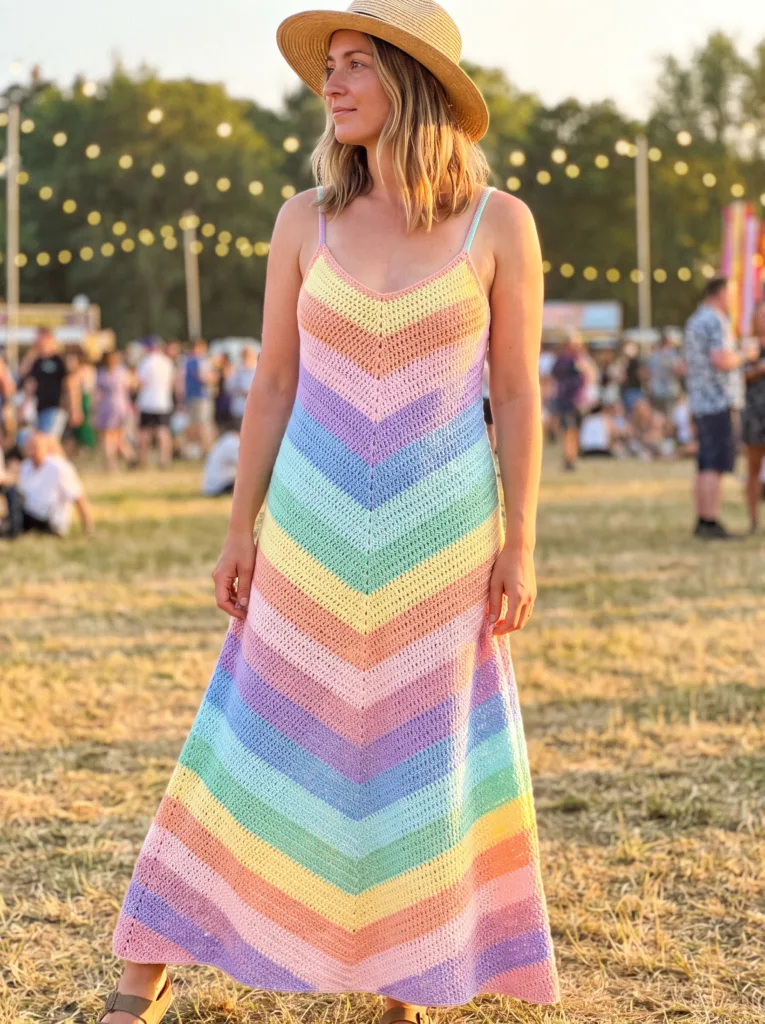
The ripple stitch is what turns a simple stripe sequence into actual chevron movement down the entire length of the dress.
The Ripple Stitch Body & Stripe Sequence
The full-length body is worked in classic ripple stitch — increase, decrease, increase along each row — using six pastel shades in sequence: blush pink, lavender, sky blue, mint, butter yellow, and peach, changing color every two rows with a 4mm hook and DK cotton throughout. The ripple’s natural peaks and valleys catch each stripe at a different point, which is what creates that soft chevron zigzag running the full length of the maxi rather than flat horizontal bands.
The Thin Straps
The straps are a simple foundation chain worked in single crochet, using whichever stripe color falls at the top of the bodice so they blend seamlessly rather than standing out as a separate element — I made them adjustable with a small button loop at the back so the dress can be lengthened slightly for different heights. Keeping the straps thin and unfussy lets the ripple stripe pattern stay the clear visual focus of the whole piece.
Yarn Suggestions to Recreate This Maxi Dress:
- Stripe colors: DK cotton in blush pink, lavender, sky blue, mint, butter yellow, peach — Hobbii Rainbow Cotton 8/4 multi-pack, or individual Scheepjes Catona shades
- Hook sizes: 4mm throughout
7. Crochet Granny Square Floral Sundress
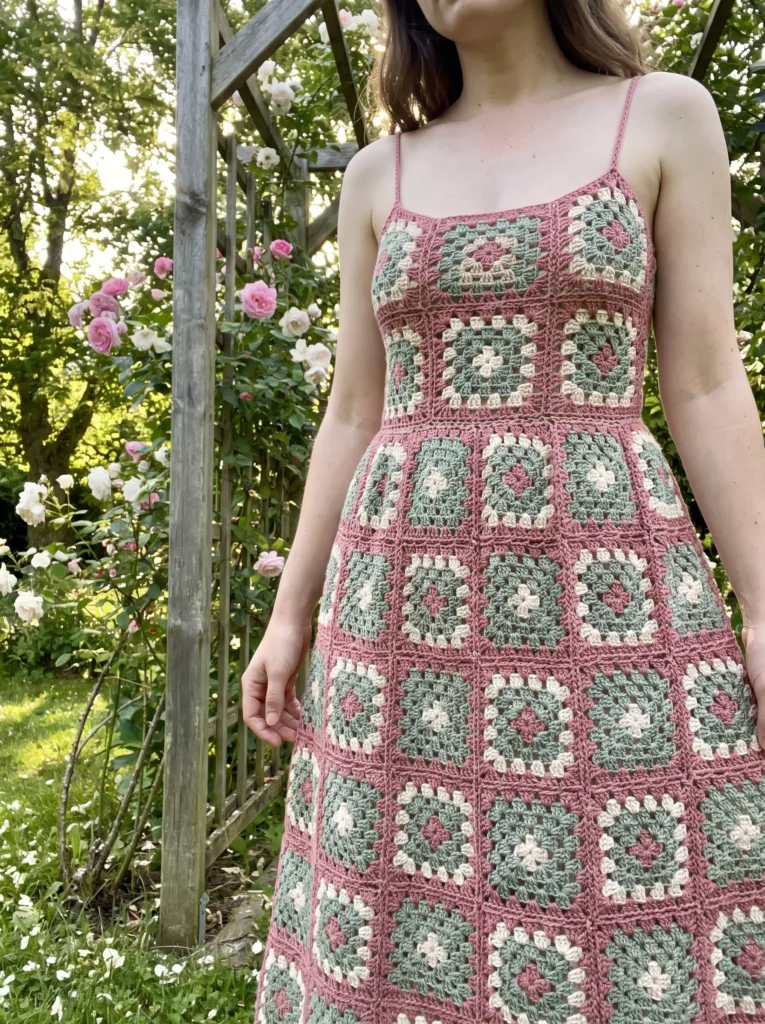
This dress is built from individually crocheted granny motifs joined together — not a continuous panel — which is why each floral square holds its shape so distinctly.
The Floral Granny Motifs
Each motif starts with a four-petal floral cluster in cream at the center, worked in the round with a 4mm hook, then I built out two rounds of dusty rose and finished with a final round of sage green to frame the flower. I crocheted 48 of these granny motifs total for this knee-length sundress, keeping every motif identical in size so the join-as-you-go seams sit flush against each other.
The Joining & Spaghetti Straps
I joined the motifs using a flat slip-stitch join through the back loops only, which keeps the seams nearly invisible from the front while still giving the dress enough structure to hold its shape on the body without a lining. The spaghetti straps are a simple twisted cord made from three strands of the sage green yarn braided together, threaded through the top corner of each shoulder motif and knotted — fully adjustable for fit.
Yarn Suggestions to Recreate This Sundress:
- Floral centers: DK cotton in cream — Scheepjes Catona Old Lace (130)
- Motif body: DK cotton in dusty rose — Paintbox Yarns Simply DK in Dusky Pink
- Motif frame: DK cotton in sage green — We Crochet Cotton Sprout in Sage
- Hook sizes: 4mm throughout
8. Crochet Deep V-Neck Beach Dress with Net Stitch Body
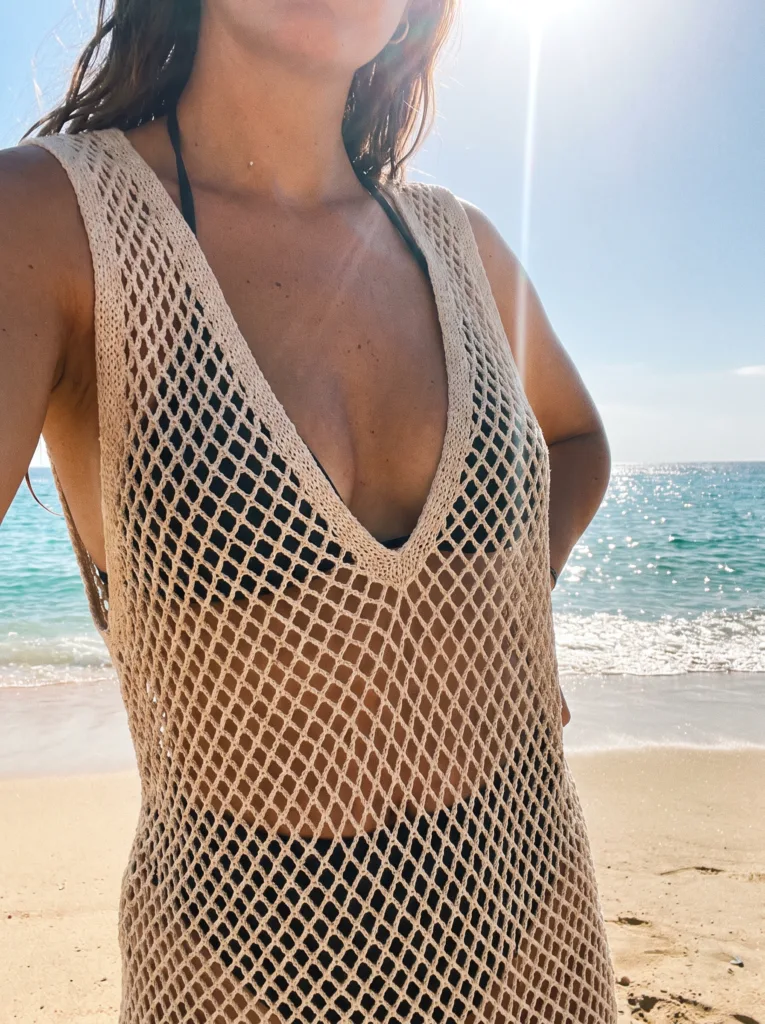
This is a true cover-up dress — the net stitch is open enough that it’s meant to be worn over a swimsuit, not on its own.
The Net Stitch Body
The entire body is worked in a simple net stitch — ch-3, skip 2, dc into the next stitch, repeated to form an open diamond mesh — using natural ecru cotton and a 5mm hook to keep the holes large and breathable. I worked it as one continuous tube from underarm to hem with no shaping, since the open net structure drapes naturally on the body regardless of fit precision.
The Deep V-Neckline
The V-neck is shaped by working two separate panels from the shoulder down to the underarm point, decreasing one stitch on the inner edge of each panel every row until they meet at the desired depth — in this version, that’s roughly sternum height, which is dramatic but still wearable over a swimsuit top. I finished the V-edge with a single round of reverse sc to keep the natural-fiber cotton from curling at this most visible edge of the dress.
Yarn Suggestions to Recreate This Beach Dress:
- Body: Worsted weight cotton in ecru — Lion Brand 24/7 Cotton in Linen
- Hook sizes: 5mm for body, 4mm for V-neck edging
9. Crochet Daisy Chain Strap Mini Dress with Flared Skirt
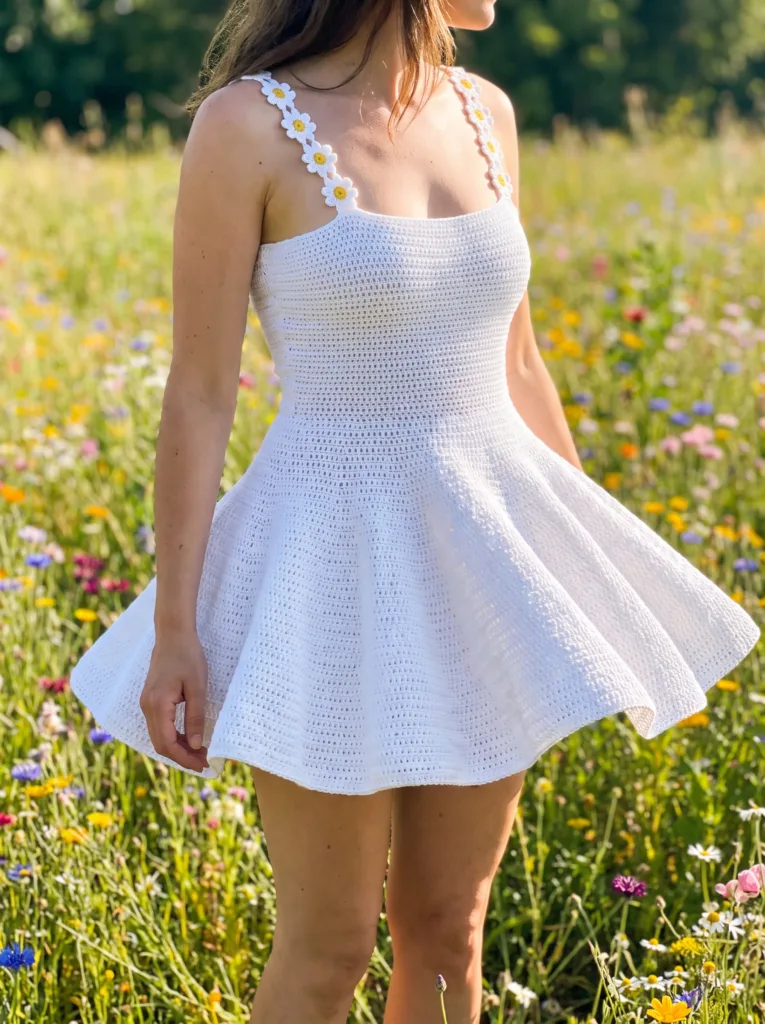
The straps here aren’t a plain chain — they’re an actual sequence of small crocheted daisies linked directly into each other.
The Fitted Bodice & Flared Skirt
The bodice is worked in double crochet using white DK cotton and a 4mm hook, fitted closely through the ribcage with princess-style increases starting at the natural waistline that flare the skirt out into a full circle by the hem. This flare is what gives the skirt its swing and movement when walking, which is the entire appeal of this particular silhouette over a straight column dress.
The Daisy Chain Straps
Each daisy motif is a quick 2-round flower — five white petals worked around a yellow french-knot style center — crocheted directly onto the top of the previous daisy rather than as separate motifs joined afterward, so the strap reads as one continuous floral chain rather than a series of attached flowers. I made each strap from six linked daisies, which lands at a comfortable shoulder length on most body types but can easily be adjusted by adding or removing a daisy.
Yarn Suggestions to Recreate This Mini Dress:
- Bodice and skirt: DK cotton in white — Scheepjes Catona Snow White (105)
- Daisy centers: small amount of DK cotton in butter yellow — Scheepjes Catona Lemon (245)
- Hook sizes: 4mm for body, 3mm for daisy motifs
10. Crochet Cut-Out Waist Cotton Dress with Breezy Openwork Texture
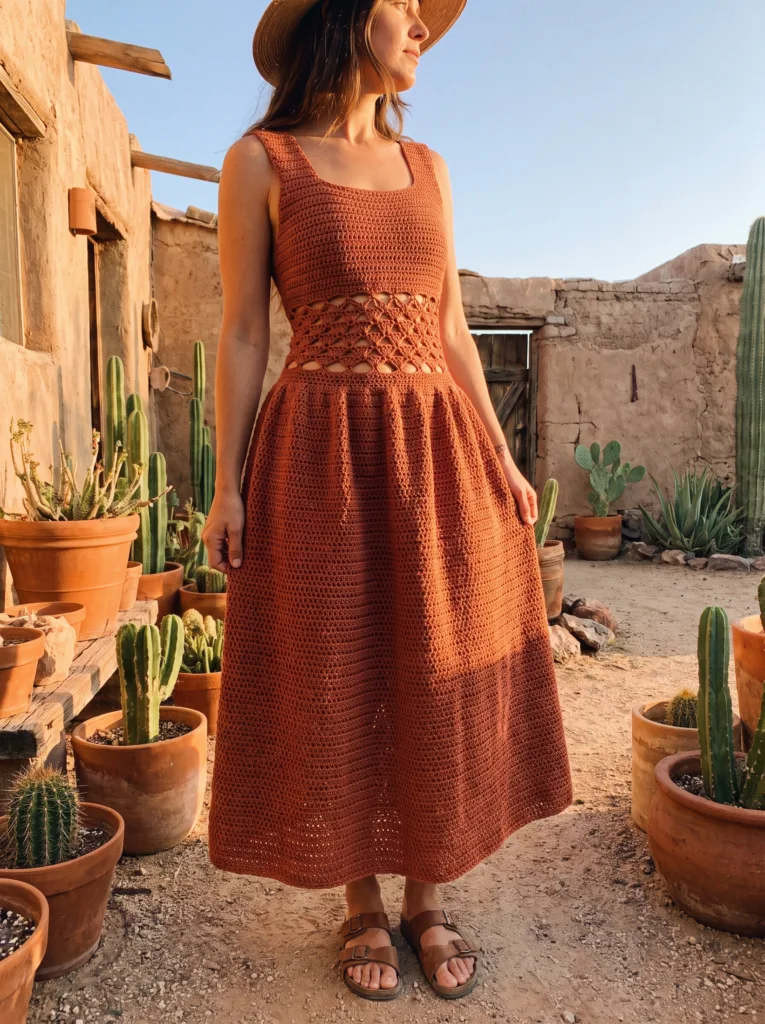
The waist cut-out is a deliberately separate openwork panel — not a gap left in solid fabric — and that distinction is what keeps the dress structurally sound.
The Solid Bodice & Skirt
Both the bodice and skirt are worked in solid double crochet using terracotta worsted weight cotton and a 4.5mm hook, which gives this dress enough structure and opacity to be worn confidently without a slip underneath. I worked these as two entirely separate pieces rather than one continuous body, which is what allows the waist section between them to be something different altogether.
The Cut-Out Waist Panel
The waist band connecting bodice to skirt is a 3-row strip of open shell stitch, worked separately and then joined to the bottom edge of the bodice and the top edge of the skirt — this creates a genuine band of visible skin at the waist rather than a sheer or holey section within solid fabric. The shell stitch’s natural give also means this waist panel has a small amount of stretch, which helps the dress move comfortably when sitting or walking.
Yarn Suggestions to Recreate This Dress:
- Bodice and skirt: Worsted weight cotton in terracotta — Paintbox Yarns Cotton DK in Burnt Orange (closest worsted match) or We Crochet Cotton Sprout in Rust
- Hook sizes: 4.5mm for bodice and skirt, 4mm for the open waist panel
11. Crochet Halter Neck Dress with Wave Stitch Flowy Skirt
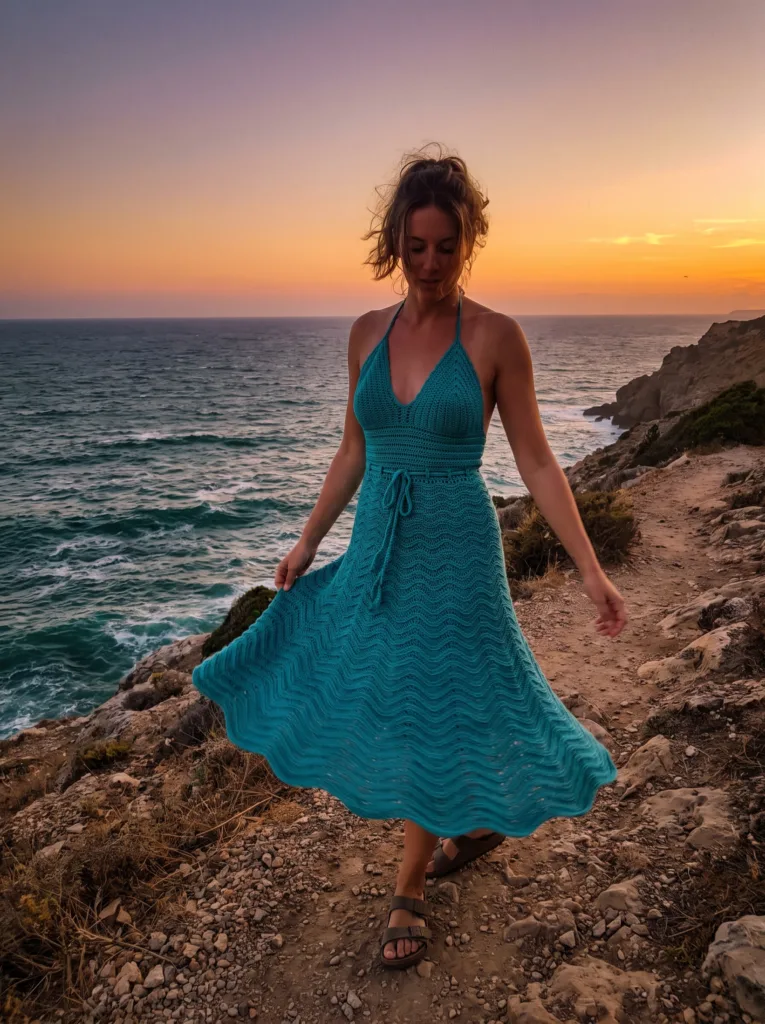
This is the one. Idea #11 consistently gets the most saves of any dress on this list — the wave stitch skirt has a visible, almost liquid movement that photographs differently in every single shot.
This dress earns its hype because the wave stitch skirt doesn’t just look textured in photos — it genuinely moves with a rippling motion that a flat stitch pattern simply cannot replicate.
The Halter Bodice
The fitted bodice is worked in solid double crochet using ocean teal DK cotton and a 4mm hook, shaped with a center front panel that narrows toward the neck and two long ties that wrap around the back of the neck and knot at the nape — I added a single row of sc reinforcement at the tie points since this is the highest-stress area on a halter garment. The bodice is fitted snugly enough to wear without additional support underneath.
The Wave Stitch Skirt
The skirt is worked entirely in wave stitch — a technique using alternating rows of front-post and back-post double crochet to create raised undulating ridges across the fabric — using the same ocean teal cotton and a slightly larger 4.5mm hook to let the ridges stand out more dramatically. This raised wave texture is what catches light differently with every step, creating that rippling, almost-liquid visual effect that makes this dress stand out in motion, not just in still photos.
Yarn Suggestions to Recreate This Halter Dress:
- Bodice and skirt: DK cotton in ocean teal — We Crochet Cotton Sprout in Teal, or Paintbox Yarns Simply DK in Kingfisher
- Hook sizes: 4mm for bodice, 4.5mm for wave stitch skirt
12. Crochet Colorblock Summer Dress with Bold Vertical Panels
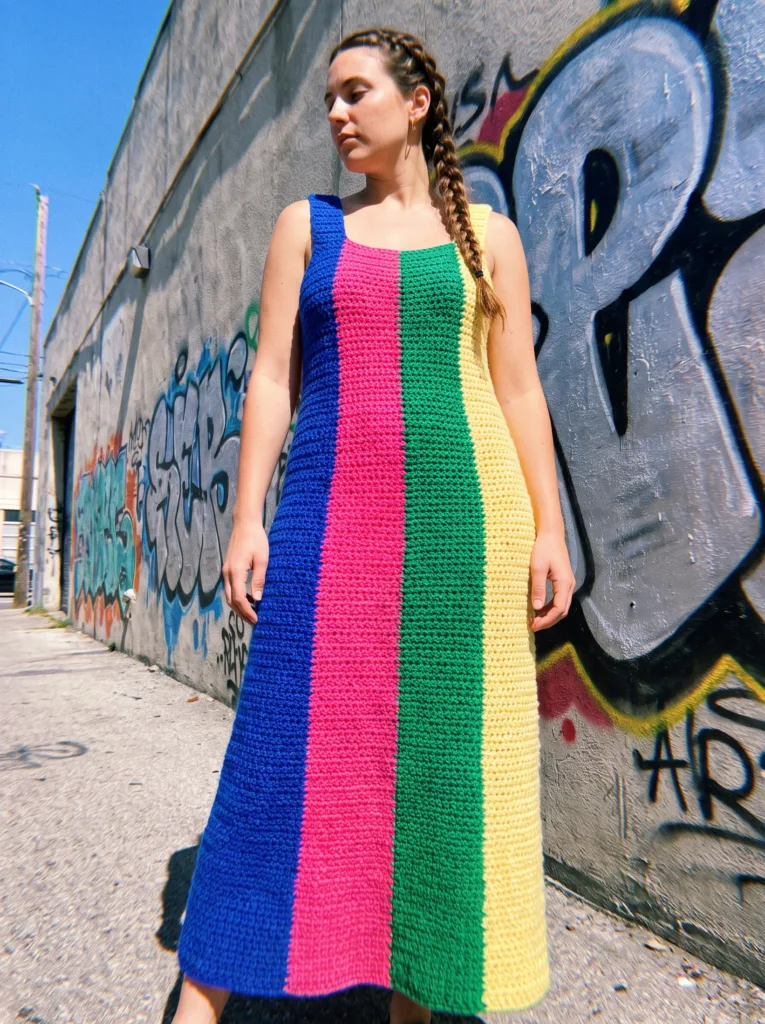
The vertical panel construction is what makes the colorblocking read as bold and intentional rather than like leftover stash yarn used randomly.
The Vertical Panel Construction
This dress is built from four separate vertical panels — cobalt blue, hot pink, emerald green, and butter yellow — each worked individually in solid double crochet from shoulder to hem using a 4mm hook and worsted weight cotton, then joined with a single slip-stitch seam down each panel division. Working each panel as its own complete piece, rather than color-changing within one continuous body, is what keeps every color division perfectly straight and vertical rather than wavy or uneven.
The Fit & Silhouette
I kept this dress in a simple straight column silhouette with minimal waist shaping, since the bold vertical color panels do all the visual work on their own — adding extra shaping or texture would compete with the colorblocking rather than support it. The hem falls at the knee with a simple unworked edge in each panel’s color, keeping the clean graphic look consistent right to the bottom.
Yarn Suggestions to Recreate This Colorblock Dress:
- Panel 1: Worsted cotton in cobalt blue — Lion Brand 24/7 Cotton in Periwinkle
- Panel 2: Worsted cotton in hot pink — Red Heart Super Saver in Hot Pink
- Panel 3: Worsted cotton in emerald green — Caron Simply Soft in Emerald
- Panel 4: Worsted cotton in butter yellow — Bernat Premium in Butterscotch
- Hook sizes: 4mm throughout
13. Crochet Backless Tie-Up Dress with Honeycomb Stitch Body
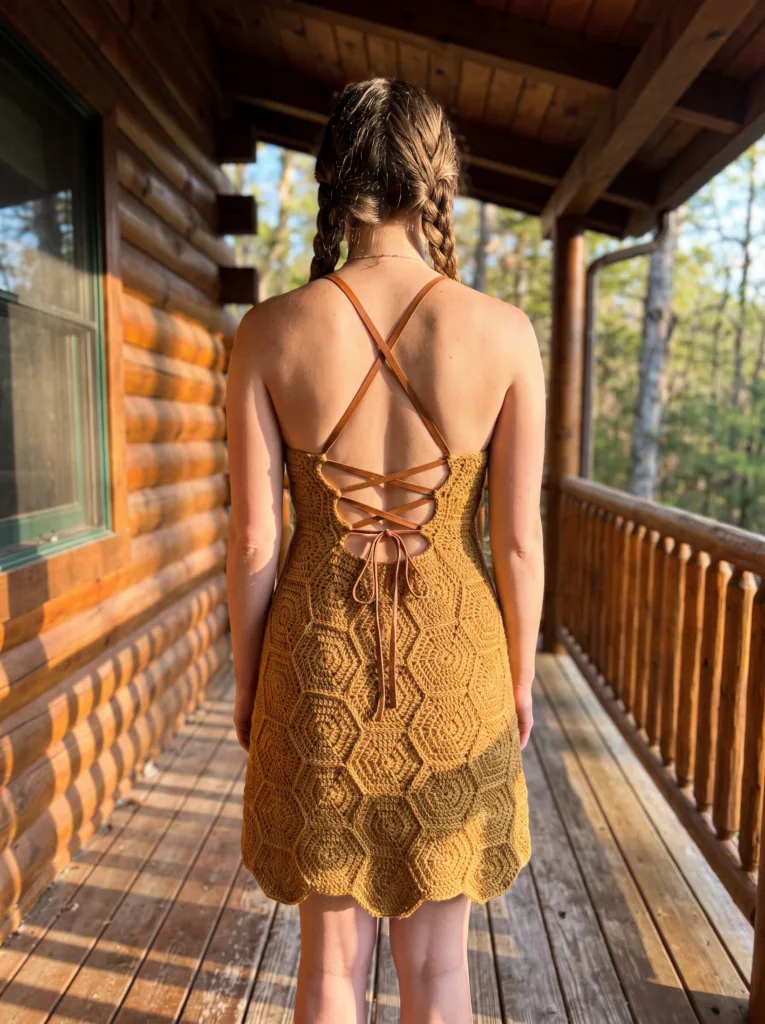
Honeycomb stitch shows up twice more before the end of this list — but this backless version is the one that uses the texture most dramatically, since the lace-up back puts it on full display.
The honeycomb stitch here isn’t just a texture choice — it’s a structural one, since the raised hexagonal pattern gives this lightweight dress enough body to hold its shape without feeling stiff.
The Honeycomb Stitch Body
The front and back panels are worked in honeycomb stitch — a combination of puff stitches and chain spaces arranged to form a raised hexagonal pattern — using honey-gold worsted cotton and a 4.5mm hook. This stitch naturally creates a slightly thicker, more structured fabric than plain double crochet, which is exactly why it works so well for a backless silhouette that needs to hold shape without a fitted lining.
The Lace-Up Back
Instead of joining the back panel as one solid piece, I left it open down the center back and worked eyelet holes at 2-inch intervals up both sides, then laced a long honey-gold cord through them in a criss-cross pattern from waist to nape, tying in a bow at the top. This lacing detail is fully adjustable, meaning the same dress comfortably fits a small range of sizes just by loosening or tightening the tie.
Yarn Suggestions to Recreate This Backless Dress:
- Body: Worsted cotton in honey-gold — Scheepjes Catona Honey Mustard (411)
- Lacing cord: Same yarn, twisted or braided for extra strength
- Hook sizes: 4.5mm for body, 3.5mm crochet hook used as a lacing tool for threading the cord
14. Crochet Tiered Ruffle Dress with Soft Lace Texture
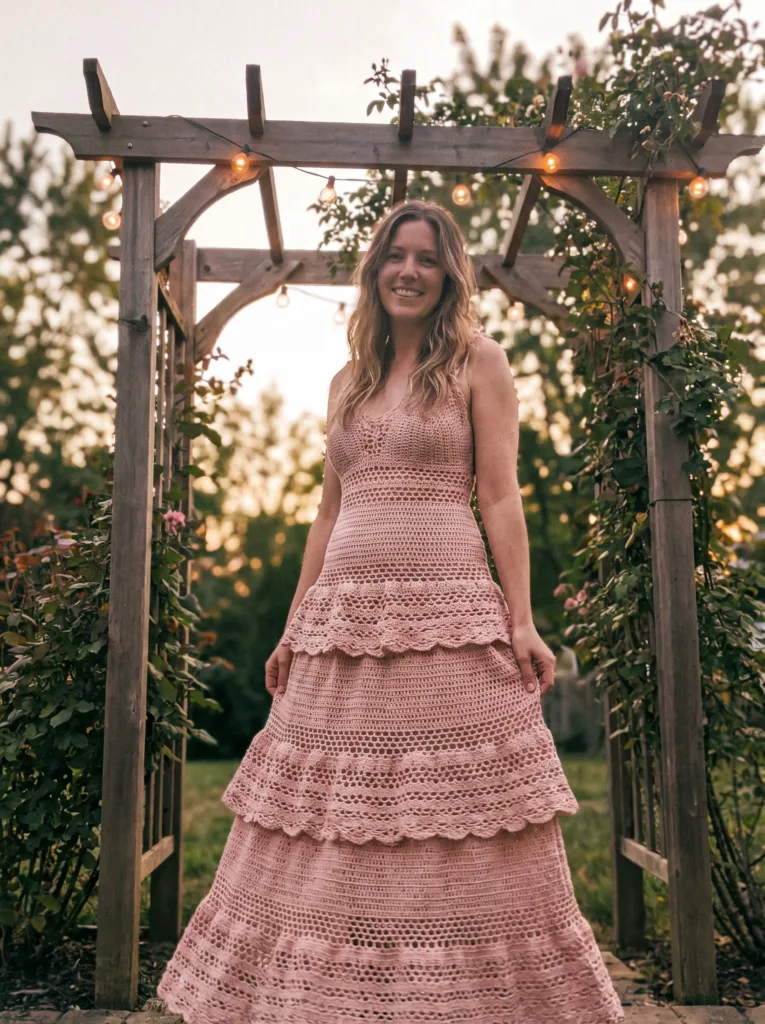
Each ruffle tier on this dress is worked as its own separate strip, then layered and joined — which is the only way to get genuine fluttering movement rather than a flat, stacked appearance.
The Fitted Bodice
The bodice is worked in a simple lace stitch — alternating dc and ch-1 spaces — using blush pink DK cotton and a 3.5mm hook, fitted snugly through the ribcage with a scoop neckline and short cap sleeves worked in the round to avoid a shoulder seam. Keeping the bodice fitted and relatively plain is intentional, since the visual interest of this dress comes entirely from what happens below the waist.
The Three Tiered Ruffles
Each of the three skirt tiers is worked flat as a long strip using the same lace stitch but with significantly more stitches than the row above it — roughly 1.5 times the stitch count — which forces the extra fabric to ruffle and flutter rather than lie flat when joined. I worked the tiers from the waist down, overlapping each new tier slightly over the raw edge of the one above it before joining with a single round of sc, which hides the seam and gives a clean, professional finish to each transition.
Yarn Suggestions to Recreate This Tiered Dress:
- Bodice: DK cotton in blush pink — Paintbox Yarns Simply DK in Blush Pink
- Skirt tiers: Same yarn, three additional skeins for the increased stitch count
- Hook sizes: 3.5mm throughout
15. Crochet Sunray Pattern Sleeveless Midi Dress
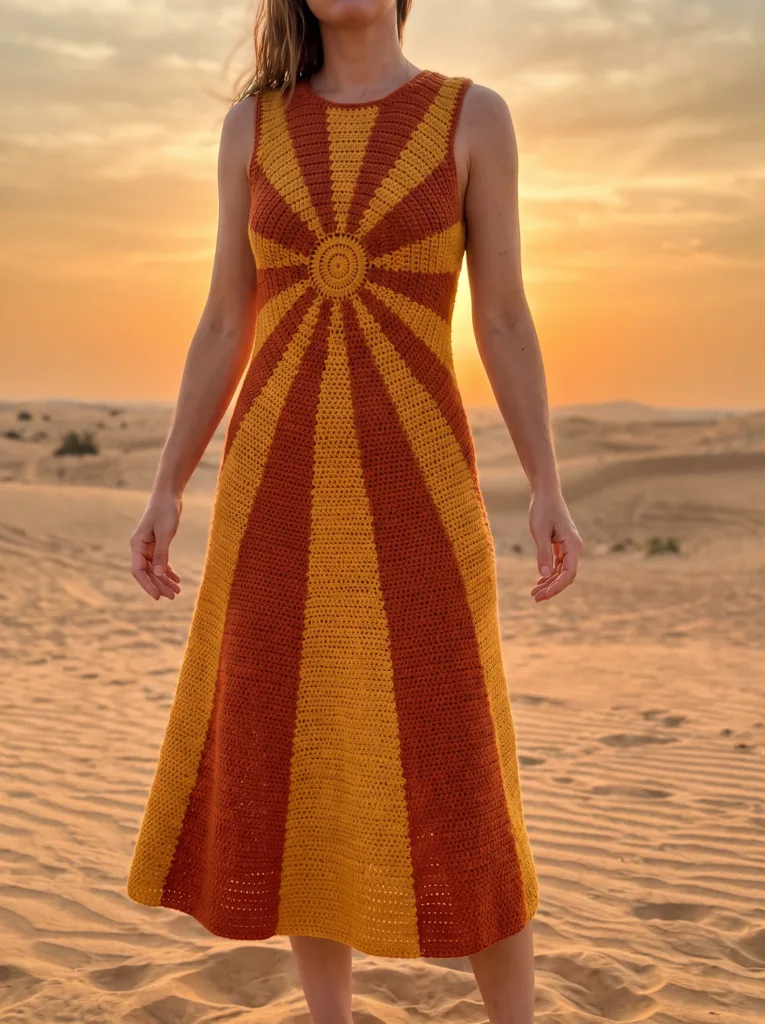
The sunray pattern is worked as a single circular motif at the chest, then the rest of the dress is built outward and downward from that center point.
The Circular Sunray Motif
I started this dress at the chest center with a circular motif worked in alternating wedge-shaped color changes — burnt orange and golden yellow — using the join-as-you-go circular method, increasing stitch count every round to keep the motif flat rather than cupping, with a 4mm hook and worsted cotton. By round 8, the motif reaches roughly chest width, at which point the wedge color changes stop and the piece transitions into solid burnt orange for the remainder of the bodice and skirt.
The Sleeveless Body & Midi Length
From the bottom edge of the sunray motif, I continued in solid double crochet down through the bodice and skirt to midi length, adding simple bound-off sleeve openings at the underarm rather than separate sleeve pieces for a clean sleeveless finish. The transition from the busy sunray pattern into solid color lower down keeps the visual focus exactly where it should be — at the radiating motif — without competing for attention down the rest of the dress.
Yarn Suggestions to Recreate This Midi Dress:
- Sunray motif: Worsted cotton in burnt orange and golden yellow — We Crochet Cotton Sprout in Rust and Honey
- Body: Worsted cotton in burnt orange — same shade as motif accent color
- Hook sizes: 4mm throughout
16. Crochet Square Neckline Dress with Puff Stitch Detailing
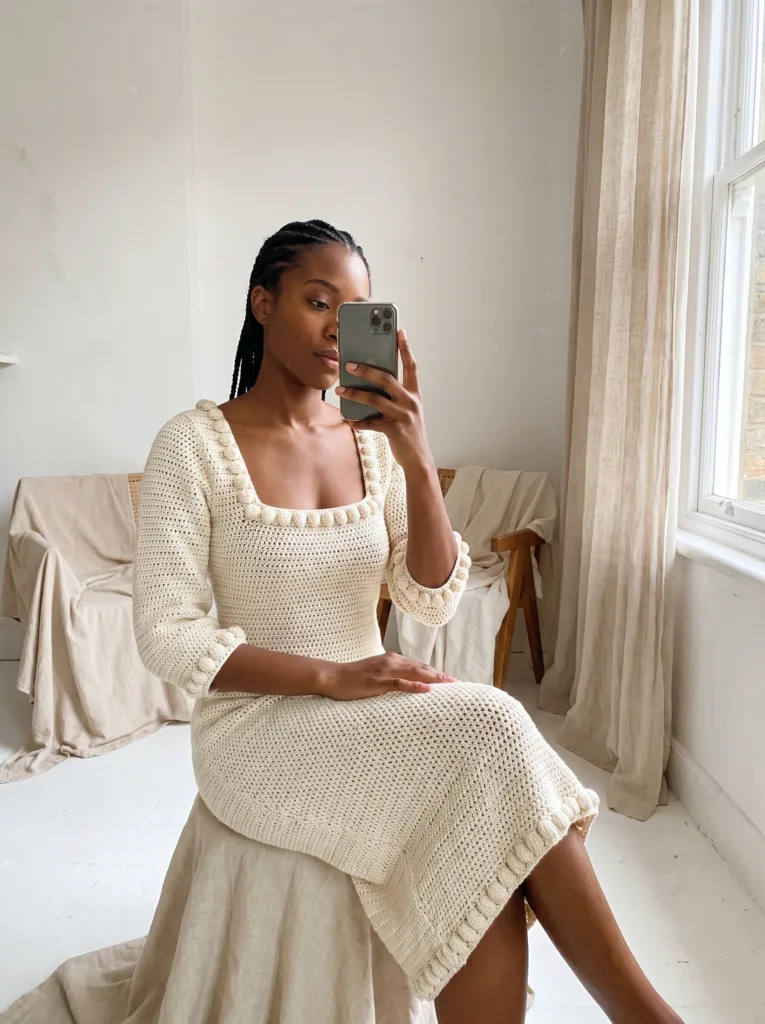
The puff stitch trim appears in exactly three places on this dress — neckline, cuffs, and hem — and that repetition is what ties the whole garment together visually.
The Body & Square Neckline
The main body is worked in plain double crochet using cream DK cotton and a 4mm hook, with the square neckline shaped the same way as idea #4 — front and back panels worked separately to the underarm and joined only at the shoulder seams for that clean, structured square edge. I added short sleeves to this version, worked in the round from the shoulder down to elbow length.
The Puff Stitch Trim
The puff stitch trim is a single round worked directly into the edge stitches at the neckline, sleeve cuffs, and hem — each puff is 5 dc worked into one stitch then drawn together with one closing stitch, repeated every third stitch around each edge. This repeated detail at three separate points on the dress is a simple trick for making a plain solid-color garment feel finished and intentional rather than unembellished.
Yarn Suggestions to Recreate This Dress:
- Body and puff trim: DK cotton in cream — Scheepjes Catona Old Lace (130)
- Hook sizes: 4mm for body, 4mm for puff stitch trim
17. Crochet Mesh Overlay Dress with Fitted Inner Lining Look
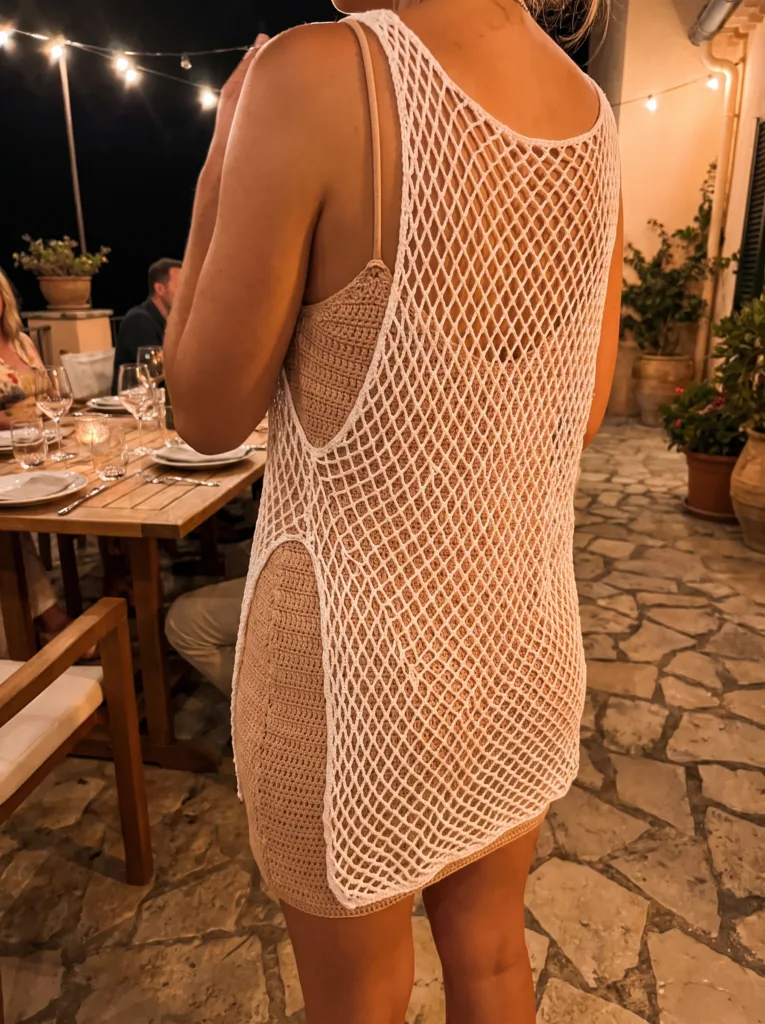
This is technically two dresses worn as one — a fitted base layer and a separate open mesh layer crocheted to fit over it.
The Fitted Base Layer
The inner layer is worked as a simple fitted slip dress in nude-toned DK cotton using a 3.5mm hook and solid double crochet throughout, sized to fit snugly against the body since its entire job is to be the color and shape the mesh overlay reveals. This base layer can technically be worn alone, but it’s designed specifically to be seen through the open mesh on top.
The Open Mesh Overlay
The overlay is a completely separate dress, worked larger and looser in white cotton using a diamond net stitch and a 5mm hook, designed to fit over the base layer with a few inches of ease so it drapes rather than clings. I joined the two layers only at the shoulder seams, letting them hang independently everywhere else, which creates subtle movement between the layers as you walk — the mesh shifts slightly differently than the fitted layer beneath it.
Yarn Suggestions to Recreate This Layered Dress:
- Base layer: DK cotton in nude/tan — Scheepjes Catona Camel (168)
- Mesh overlay: DK cotton in white — Scheepjes Catona Snow White (105)
- Hook sizes: 3.5mm for base layer, 5mm for mesh overlay
18. Crochet Tropical Leaf Motif Mini Dress with Side Ties
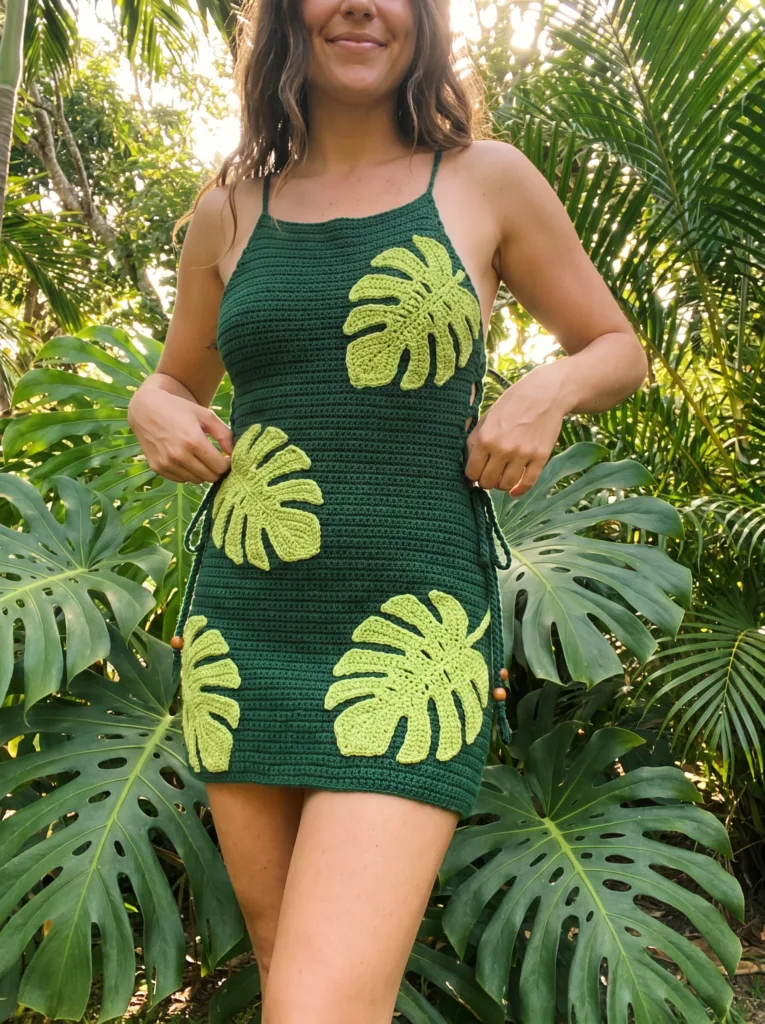
The palm leaf motifs here are worked as individual elongated leaf shapes, each with a raised center vein, then sewn onto a plain base dress.
The Base Dress & Side Ties
The base dress is a simple A-line shape worked in tropical green double crochet using a 4mm hook and worsted cotton, with a side tie construction at the waist — rather than a fixed seam — created by leaving 3 inches open on each side and adding two long cords that tie into a bow, allowing the fit to be adjusted looser or tighter. This adjustable tie detail is genuinely useful for a dress meant to be worn and re-worn across a body that might fluctuate slightly season to season.
The Tropical Leaf Motifs
Each palm leaf motif is worked flat in a slightly darker forest green, starting with a center chain spine and working elongated single crochet “fronds” out from each side to create the leaf shape, finished with a few rows of surface slip stitch along the spine to mimic a raised vein. I made seven leaves of varying sizes and arranged them in an overlapping cluster across one side of the bodice before sewing each one in place individually.
Yarn Suggestions to Recreate This Mini Dress:
- Base dress: Worsted cotton in tropical green — Paintbox Yarns Simply DK in Kingfisher (closest tropical green-blue) or We Crochet Cotton Sprout in Emerald
- Leaf motifs: Worsted cotton in forest green — Lion Brand 24/7 Cotton in Pine
- Hook sizes: 4mm for base dress, 3.5mm for leaf motifs
19. Crochet Strapless Bandeau Dress with Textured Stitch Pattern
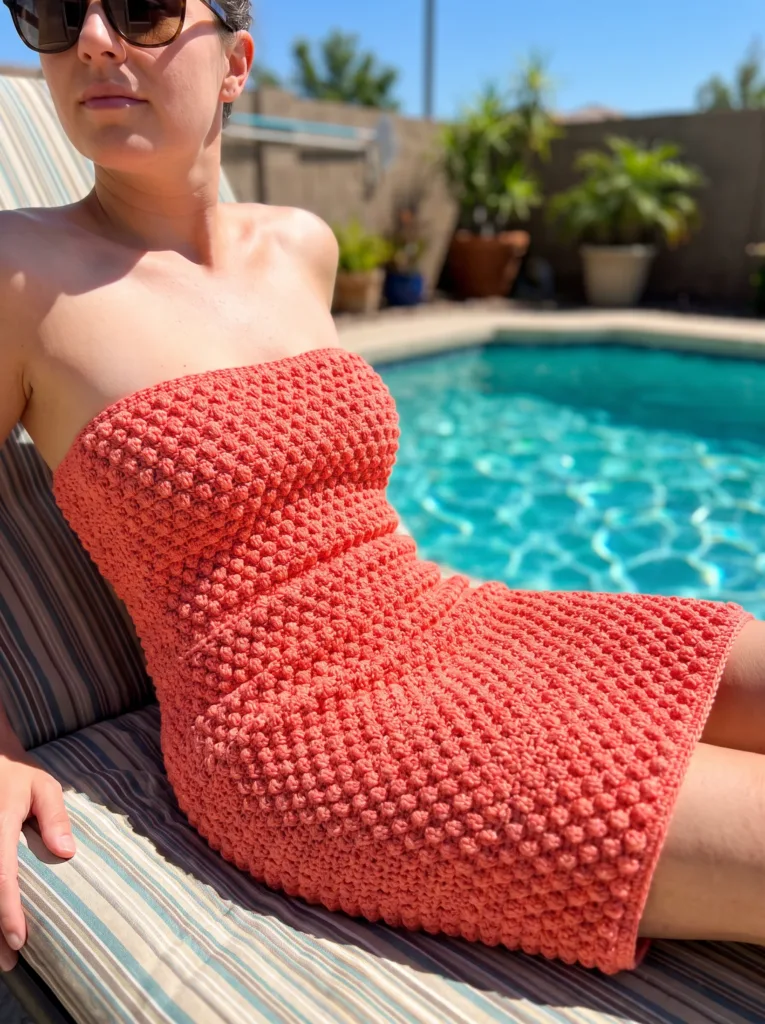
A strapless crochet dress needs serious structural integrity to actually stay up — and that’s exactly what this dense textured stitch pattern provides.
The Strapless Bodice Structure
The bodice is worked in a dense cluster stitch — a combination of bobble and post stitches packed tightly together — using coral worsted cotton and a 3.5mm hook, intentionally tighter gauge than the rest of the dress to create enough rigidity and grip to stay up without straps. I worked a separate elastic-thread casing into the top inside edge of the bodice, threading clear elastic through it after blocking, which is the real secret to a strapless crochet piece that doesn’t slip down throughout the day.
The Textured Pattern Transition
Below the bust, the dense cluster stitch gradually transitions into a looser version of the same texture down through the skirt, achieved by switching to a slightly larger 4.5mm hook at the natural waistline while keeping the same stitch pattern. This gradual texture loosening keeps visual consistency throughout the dress while giving the skirt enough movement and ease that the dense bodice doesn’t extend uncomfortably down the entire body.
Yarn Suggestions to Recreate This Bandeau Dress:
- Bodice and skirt: Worsted cotton in coral — Caron Simply Soft in Persimmon, or Red Heart Soft in Coral
- Hook sizes: 3.5mm for bodice, 4.5mm for skirt; clear elastic thread for the bust casing
20. Crochet High Slit Summer Dress with Airy Diamond Stitch
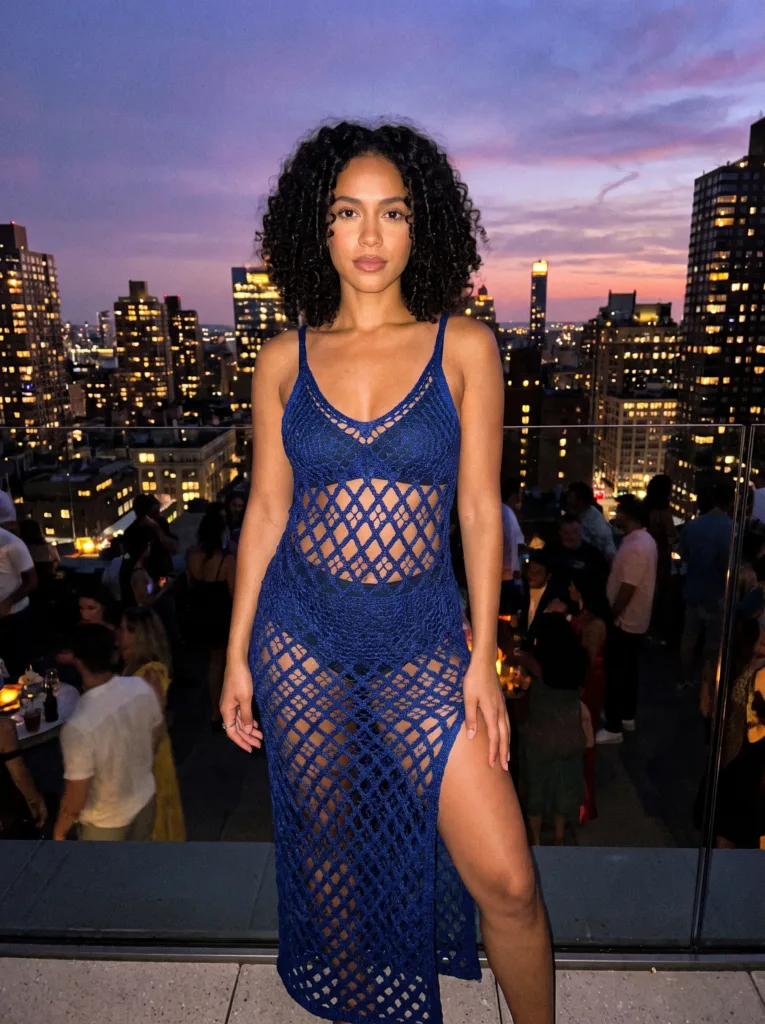
The diamond lattice pattern and the high slit work together here — the open stitch structure makes the slit feel like a continuation of the dress’s airiness rather than an abrupt cut.
The Diamond Lattice Body
The full body of this dress is worked in an open diamond lattice stitch — a pattern of crossed double crochet stitches worked over chain spaces to form a diagonal grid — using deep sapphire blue DK cotton and a 4.5mm hook, kept consistent from neckline to hem with no solid sections breaking up the open texture. This consistent open lattice throughout is what gives the entire dress a cohesive, intentional airiness rather than feeling like a solid dress with one slit cut into it.
The High Slit
The thigh-high slit is built into the construction from the start — I simply worked the front skirt panel as two separate sections from the hip down on one side only, rather than joining them, which avoids any cut fabric edges that could fray or need reinforcement. A single round of sc along both slit edges keeps them defined and prevents the open lattice stitch from stretching out of shape at this high-movement area of the dress.
Yarn Suggestions to Recreate This Dress:
- Body: DK cotton in deep sapphire blue — We Crochet Cotton Sprout in Sapphire, or Paintbox Yarns Simply DK in Lapis Blue
- Hook sizes: 4.5mm throughout, 4mm for slit edge reinforcement
21. Crochet Peplum Style Crochet Dress with Soft Flared Hem
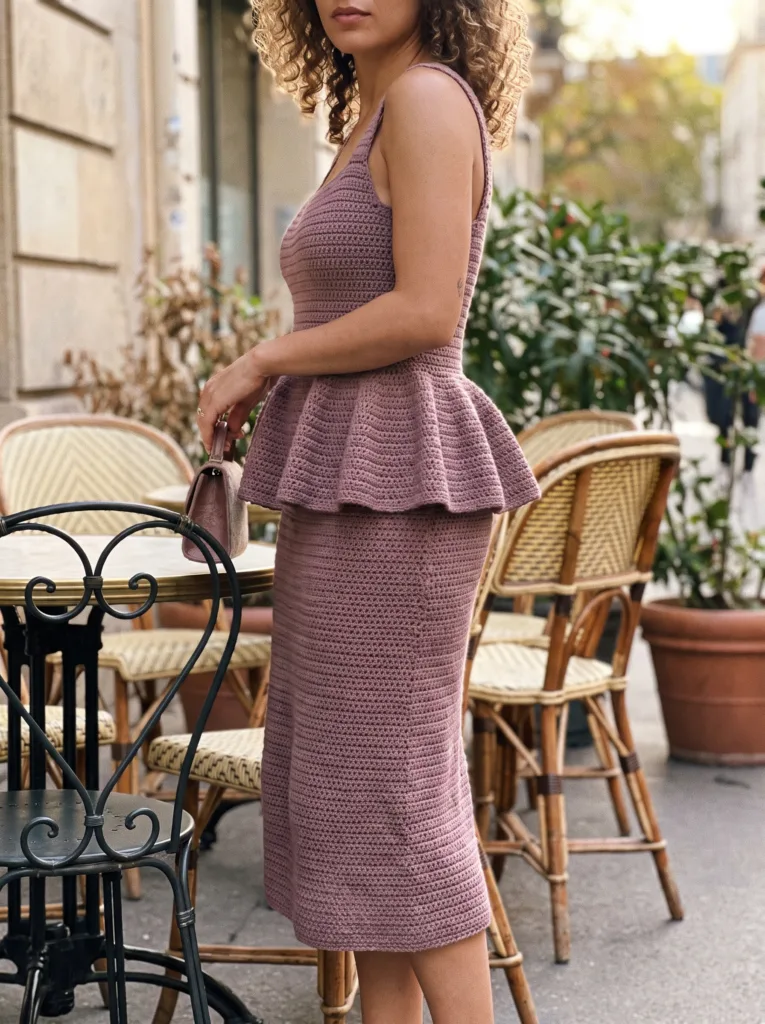
The peplum here is a genuinely separate piece, not just an extra-flared row built into the main body — and that separation is what gives it its crisp, structural flounce.
The Fitted Bodice and Straight Skirt
The bodice and skirt are both worked in solid double crochet using dusty mauve worsted cotton and a 4mm hook, with the bodice fitted closely through the waist and the skirt falling in a relatively straight, fairly fitted line down to the knee — deliberately understated so the peplum has something structured to flare out from. Without a fitted base, a peplum tends to lose its shape and just blend into a generally flared skirt.
The Peplum Flounce
The peplum itself is crocheted as a separate circular ruffle piece, worked with significant stitch increases every row to create that wide, structured flare, then sewn onto the dress at the natural waistline so it sits proud of the body rather than skimming it. I used a slightly stiffer cotton blend for just this piece compared to the rest of the dress, which helps the peplum hold its flared shape rather than drooping under its own weight over time.
Yarn Suggestions to Recreate This Peplum Dress:
- Bodice and skirt: Worsted cotton in dusty mauve — Paintbox Yarns Cotton DK in Dusky Pink
- Peplum: Stiffer cotton blend in matching dusty mauve — Lion Brand 24/7 Cotton in similar rose tone, held with a strand of fine cotton for extra body
- Hook sizes: 4mm for bodice and skirt, 3.5mm for the structured peplum
22. Crochet Minimalist Straight Cut Dress with Fine Linen Stitch
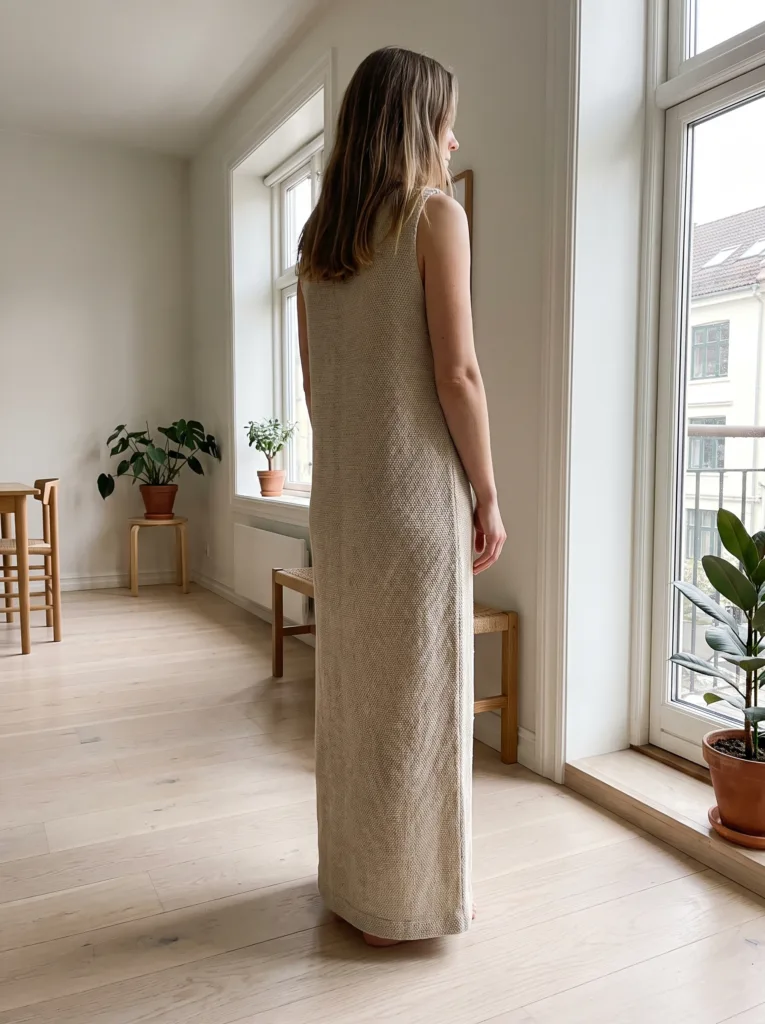
This dress proves crochet doesn’t have to look “crocheted” — the fine, tight stitch gauge here genuinely reads as woven linen fabric from a few feet away.
The Fine Linen Stitch Texture
The entire dress is worked in a tight single crochet variant — worked through both loops with a smaller-than-usual 3mm hook on fingering weight linen-blend yarn — which produces an unusually dense, flat fabric closer in appearance to woven cloth than typical crochet texture. This tight gauge takes considerably longer to work than a standard DK project, but the resulting fabric drapes and moves like real linen rather than holding the slightly stiff structure crochet often has.
The Straight Column Silhouette
I kept the construction deliberately simple — a straight column shape with no waist shaping, no darts, and minimal ease — since the entire visual interest of this dress comes from the fabric quality itself rather than silhouette drama. Side slits to the knee on both sides allow for ease of movement that the straight, unshaped cut would otherwise restrict.
Yarn Suggestions to Recreate This Minimalist Dress:
- Body: Fingering weight linen-cotton blend in oatmeal — DMC Natura Just Cotton in Écru, or We Crochet Cotton Sprout in Oatmeal
- Hook sizes: 3mm throughout
23. Crochet Halter Wrap Dress with Open Back Detail
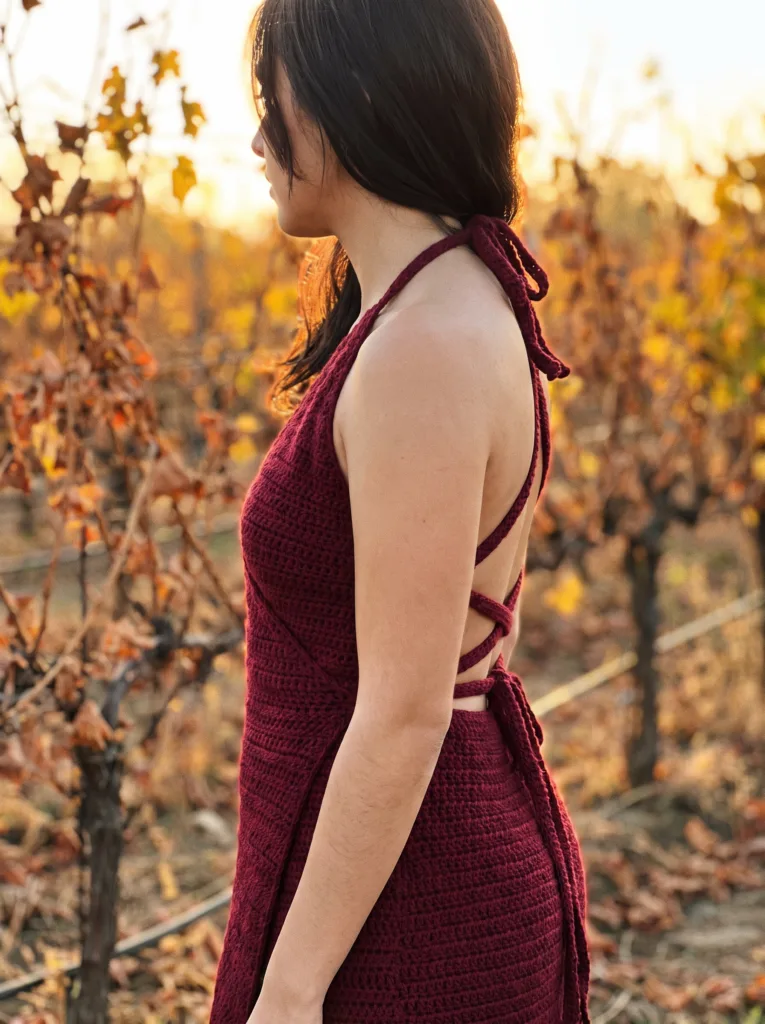
The wrap front and open back work together as one continuous construction here, rather than as two separate design features bolted onto a standard dress.
The Wrap Front Closure
This dress is built from two long panels that cross over each other at the front — worked in deep wine red worsted cotton with a 4mm hook in solid double crochet — with one panel extending further to wrap around and tie at the side waist, creating that classic wrap-dress V at the chest. Because it’s a genuine wrap construction rather than a fixed closure, this dress actually adjusts to fit a range of body sizes simply by how tightly it’s wrapped and tied.
The Halter Neck & Open Back
From the wrap point at the chest, the fabric continues up and over each shoulder as a halter strap that crosses behind the neck and ties, leaving the entire back open down to the waist wrap point — I added two thin crossed straps down the spine purely for visual interest and slight support, since the wrap tie at the waist already secures the dress on the body. This open-back detail is what elevates the dress from a simple wrap style into something with genuine evening-wear visual drama.
Yarn Suggestions to Recreate This Wrap Dress:
- Body: Worsted cotton in deep wine red — Caron Simply Soft in Burgundy, or Scheepjes Catona Bordeaux (192)
- Hook sizes: 4mm throughout
24. Crochet Ombre Gradient Beach Dress with Light Mesh Structure
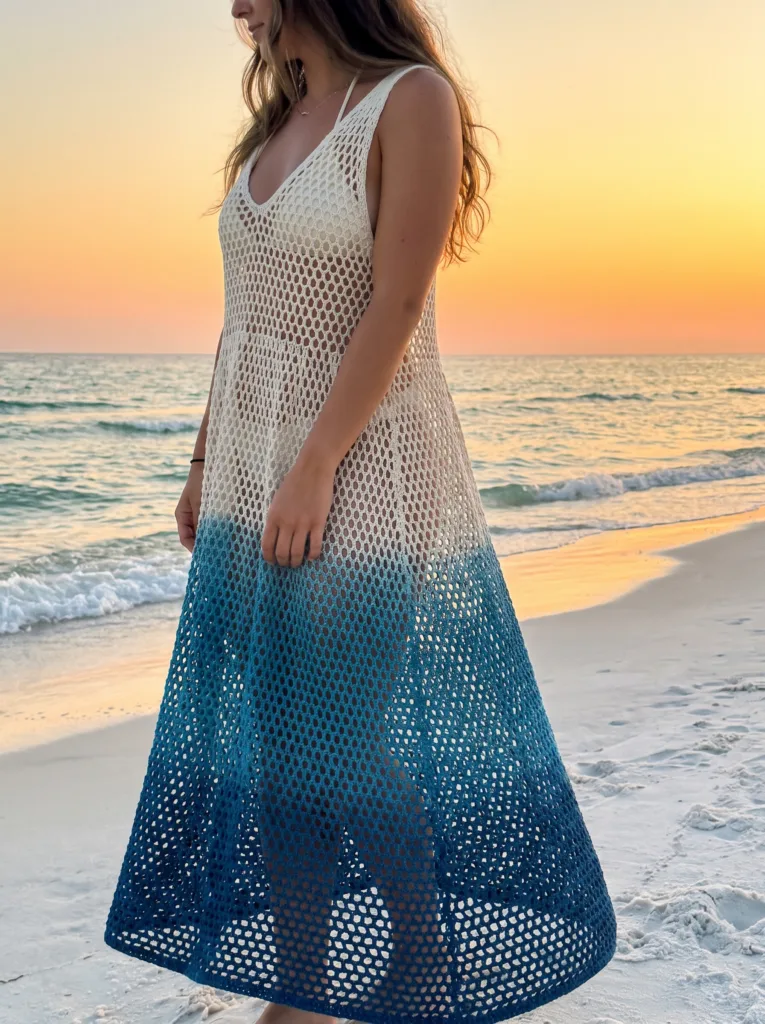
The gradient here isn’t achieved with a single variegated skein — it’s built deliberately row by row using carefully blended color transitions between five separate shades.
The Open Mesh Structure
The entire dress is worked in a simple open mesh — ch-1, dc, repeated — using a 5mm hook and DK weight cotton, kept lightweight and airy throughout since this is designed purely as a beach cover-up rather than a structured garment. The open mesh also makes the color transitions read more softly and blended than they would in a dense solid stitch, since the eye naturally blurs the color changes slightly through the open spaces.
The Five-Shade Gradient
I worked the gradient using five separate shades — white, pale blue, sky blue, teal, and ocean blue — changing color gradually over 4-row sections rather than abrupt single-row switches, which is what creates that soft fade rather than visible stripe bands. Blending colors gradually like this requires carrying the previous color for one row into the new color’s section, alternating stitches between the two for a true gradient blur rather than a hard line.
Yarn Suggestions to Recreate This Ombre Dress:
- Gradient shades: DK cotton in white, pale blue, sky blue, teal, ocean blue — Scheepjes Catona shades Snow White, Powder Blue, Bluebell, Tropic, and Royal Navy as the darkest end, or a pre-made gradient cake like Lion Brand Mandala in an ocean colorway
- Hook sizes: 5mm throughout
25. Crochet Corset-Style Lace-Up Summer Dress with Open Sides
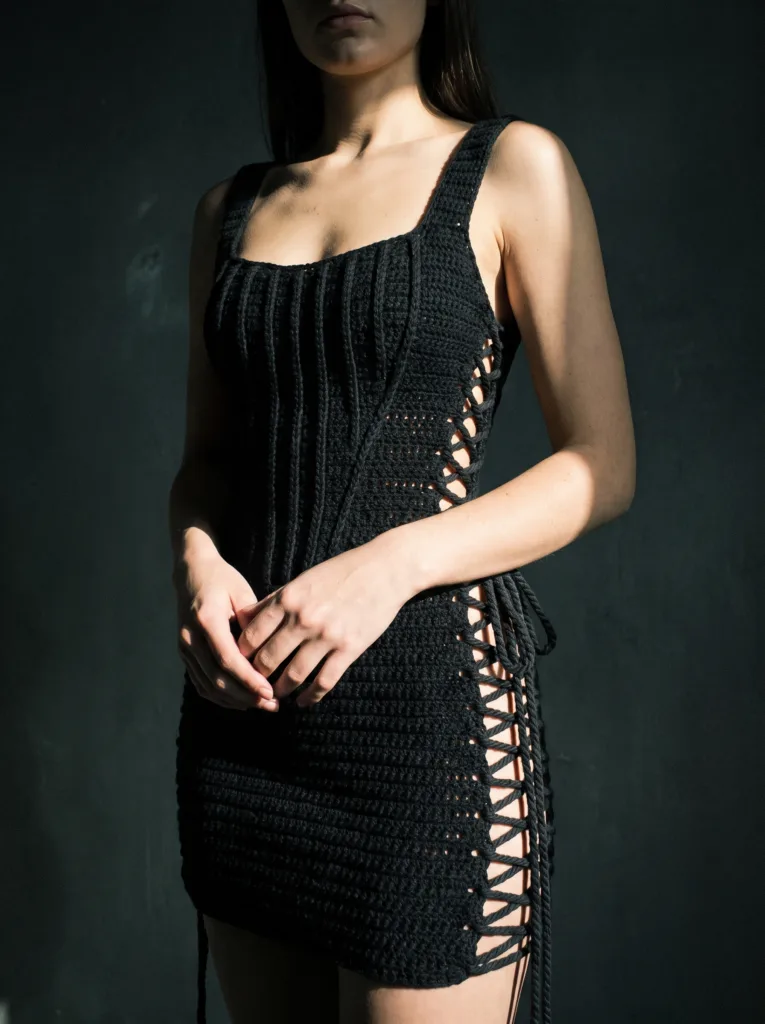
This is idea #25 — the one we mentioned at the very start of this list, and the one that consistently gets the most questions in our comments about construction.
The structured look of this corset bodice comes entirely from post-stitch ribbing, not from any actual boning — and that’s exactly why people are surprised when they learn how it’s made.
The Corset-Look Ribbed Bodice
The bodice is worked using alternating front-post and back-post double crochet in tight vertical columns — using black worsted cotton and a 3.5mm hook — which creates a raised ribbed texture that visually mimics the vertical seaming of an actual corset without any boning, wire, or stiffening inserted. This post-stitch ribbing also naturally has more structure and less stretch than plain double crochet, which genuinely does help the bodice hold a more fitted, supportive shape against the body.
The Lace-Up Side Detail
Instead of joining the side seams solidly, I left eyelet gaps at 1.5-inch intervals down both sides from underarm to hip and laced a black cord through them in a corset-style criss-cross pattern, tying at the bottom of each side — this is what creates the visible skin gaps along the sides and allows the fit to be adjusted by loosening or tightening the lacing. The skirt below the bodice is worked in plain double crochet with no further lacing, keeping all the structural drama contained to the torso.
Yarn Suggestions to Recreate This Corset Dress:
- Bodice and skirt: Worsted cotton in black — Red Heart Super Saver in Black, or Lion Brand 24/7 Cotton in Black
- Lacing cord: Same yarn twisted into a firm cord, or a separate black ribbon
- Hook sizes: 3.5mm for ribbed bodice, 4mm for skirt
26. Crochet Boho Fringe Hem Dress with Relaxed Silhouette
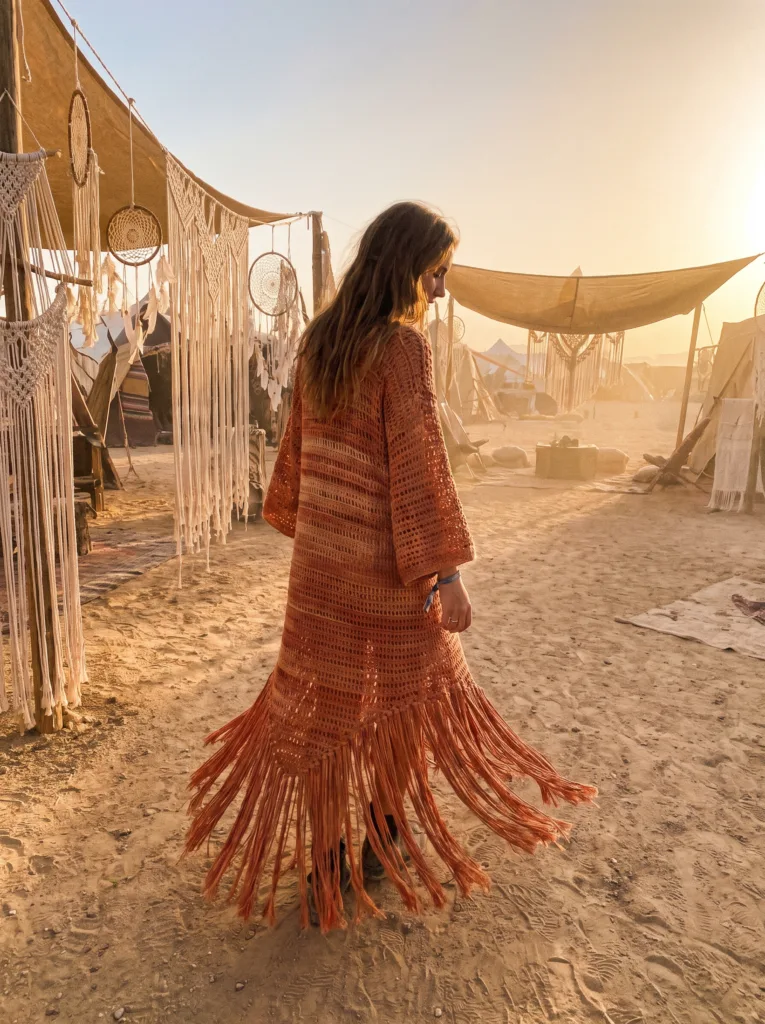
The fringe at the hem isn’t an afterthought trim sewn on at the end — it’s worked directly into the final round using long cut strands pulled through every stitch.
The Relaxed Silhouette
This dress is worked in solid double crochet using terracotta worsted cotton and a 4.5mm hook, with deliberately generous ease throughout — roughly 4 inches of extra room at the bust and hip compared to a fitted dress — giving it that loose, easy, boho drape rather than clinging to the body. Wide drop shoulders and a relaxed scoop neckline continue that same unfussy, relaxed feeling through the upper body.
The Fringe Hemline
The fringe is created by cutting 8-inch lengths of the same terracotta yarn and pulling a folded loop through every single stitch along the final hem round, then trimming all the fringe ends to an even length once the loops are secured — this is the same basic technique used for fringe on a macrame wall hanging or scarf. Working dense fringe into every stitch, rather than every other stitch, is what gives this hemline its thick, substantial swing rather than a sparse, thin fringe line.
Yarn Suggestions to Recreate This Boho Dress:
- Body: Worsted cotton in terracotta — We Crochet Cotton Sprout in Rust, or Paintbox Yarns Simply DK in Burnt Orange
- Fringe: Same yarn, additional skeins for the dense fringe trim
- Hook sizes: 4.5mm throughout
27. Crochet Asymmetrical One-Shoulder Crochet Summer Dress
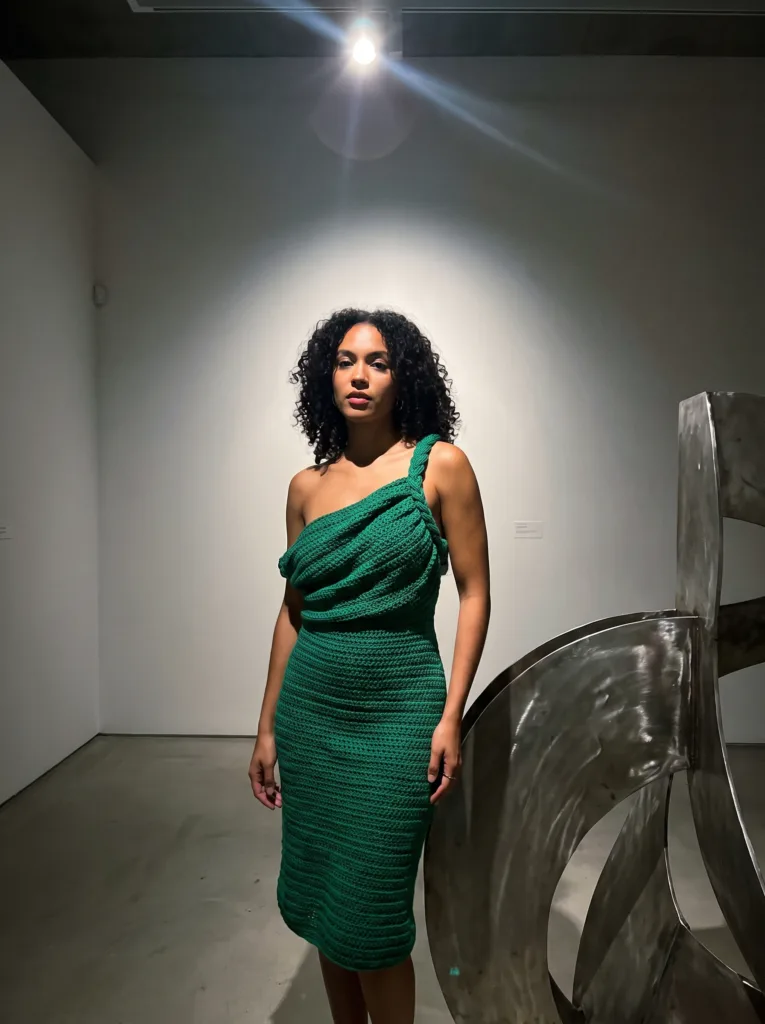
The final dress on this list, and the trickiest to construct — the asymmetry here means the left and right sides of the bodice are genuinely worked as two different pattern pieces.
The Asymmetrical Bodice
Unlike every other dress on this list, the two sides of this bodice are not mirror images of each other — the right side is worked with a fitted strap up to the shoulder while the left side curves into a bare shoulder line with no strap at all, using emerald green worsted cotton and a 4mm hook in solid double crochet. I worked each side as its own panel with different row counts and shaping before joining them at a diagonal center seam, since trying to chart this asymmetry as one continuous piece becomes confusing very quickly.
The Draped Diagonal Neckline
The diagonal neckline drape is created by working a few short rows of increases at the chest just below the strap side, which adds just enough extra fabric to create a soft folded drape effect crossing toward the bare shoulder side, rather than a flat straight diagonal line. This small amount of extra ease at exactly the right point is the difference between a neckline that looks intentionally draped versus one that just looks like a straight cut at an angle.
Yarn Suggestions to Recreate This One-Shoulder Dress:
- Body: Worsted cotton in emerald green — Caron Simply Soft in Emerald, or Lion Brand 24/7 Cotton in Emerald
- Hook sizes: 4mm throughout
Frequently Asked Questions
What is the best crochet stitch for a summer dress?
It depends on what you want the dress to do. For airy, breathable pieces, filet lace, net stitch, and open mesh let air circulate while still holding shape — ideal for beach cover-ups and hot-climate wear. For dresses that need to hold their form without a lining, denser textures like honeycomb stitch, post-stitch ribbing, or shell stitch give more structure. Ripple and wave stitch are best when you want visible movement and texture that catches light as you walk, which is why they show up so often in this list.
What yarn weight works best for crochet dresses?
DK weight cotton is the most versatile choice for crochet dresses — it holds stitch definition clearly without being too heavy to wear comfortably in summer heat. Worsted weight works well for dresses that need more structure, like the corset-style or peplum designs on this list. Fingering weight, paired with a smaller hook, produces the tightest, most fabric-like drape, as seen in the minimalist linen-stitch dress, but takes significantly longer to complete.
How much yarn do I need to crochet a summer dress?
Most knee-length crochet dresses in DK weight cotton use between 600 and 900 grams of yarn, depending on size and how dense the stitch pattern is. Open, airy stitches like mesh or filet lace use less yarn than dense textures like honeycomb or cluster stitch. Maxi dresses and pieces with separate elements — like the layered mesh overlay or the tiered ruffle dress — will need yarn calculated separately for each component, so always buy slightly more than your estimate to avoid a dye lot mismatch mid-project.
Can crochet dresses be worn without anything underneath?
This depends entirely on the stitch density and your own comfort level. Open stitches like net stitch, filet lace, and diamond lattice are intentionally see-through and are typically styled as beach cover-ups worn over a swimsuit, not as standalone outfits. Denser stitches like solid double crochet, honeycomb, or post-stitch ribbing are opaque enough to wear with just appropriate undergarments, similar to a regular fabric dress. When in doubt, hold the finished fabric up to a bright light to check opacity before deciding.
What size hook should beginners use for their first crochet dress?
Beginners should start with a 4mm or 4.5mm hook and DK weight cotton, which is forgiving enough to maintain even tension while you’re still building muscle memory for garment-scale projects. Avoid starting with anything smaller than 3.5mm or with fingering weight yarn, since tight, small-gauge work like the minimalist linen-stitch dress in this list requires more hand control. Simple, solid-stitch silhouettes — like the colorblock dress or the minimalist straight cut — make better first garment projects than heavily textured or asymmetrical designs.
Which One Is Your Favorite?
From the open-back shell stitch sundress that opened this list to the asymmetrical one-shoulder dress that closed it, these 27 crochet dress ideas for summer prove that handmade doesn’t have to mean homemade-looking. Whether you’re drawn to the rippling wave stitch halter at #11 or the dramatic corset lacing at #25, every silhouette here is built to actually be worn out into the world.
Which dress are you making first? Tell us in the comments — and let us know if you land on the daisy chain mini at #9 or the boho fringe dress at #26, because that’s the debate our readers can never settle. If you make any of these, tag us — we genuinely want to see them on a real body in real sunlight.