
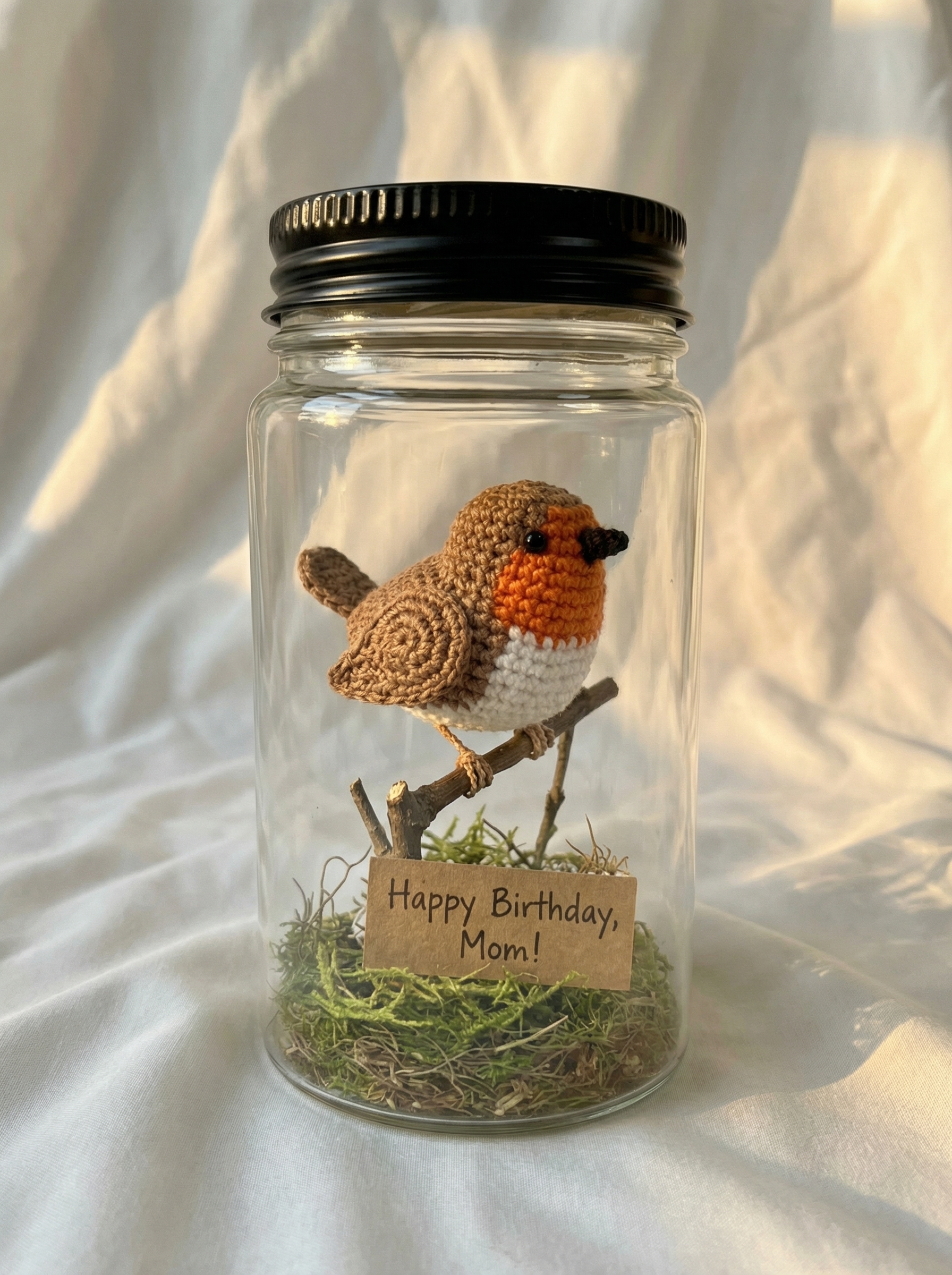
Creating a tiny, handmade amigurumi bird is one of the most satisfying crochet projects you can do. It’s a wonderful chance to work with beautiful colors and create a small, charming friend to brighten up any room. With this free pattern, I’ll show you exactly how to make a classic and absolutely adorable little robin.
This is a fantastic pattern if you’re looking for a quick and rewarding make. I designed it for confident beginners who are comfortable with basic stitches and are ready to try some fun color changes. The result is a sweet, pocket-sized bird with that iconic, cheerful red breast and a soft white belly—a look that’s impossible not to love. It’s an ideal pattern for weekend crafting, popular craft fair projects, or as a thoughtful, handmade gift.
The construction method we’ll use is really clever. We make the head and tail first, then join them together to form the body with very little sewing. It’s a great technique to add to your crochet skills! Let’s grab our yarn and make this sweet little bird.
Essential Supplies for Your Amigurumi Bird
Choosing the right materials is a key step for any amigurumi project. For a small, detailed amigurumi bird like our robin, cotton yarn is a great choice. It doesn’t stretch much, which means your bird will keep its nice, firm shape, and it really makes your stitches look crisp and clean.
While you can use any DK weight cotton you like, some are easier to work with than others. Here’s a quick look at a few popular yarns available in the USA that are fantastic for this kind of project.
A Quick Guide: Top Cotton Yarns for Amigurumi
| Yarn | Why I Like It | Best For |
|---|---|---|
| Paintbox Yarns Cotton DK | This is my go-to. The color range is huge, so you can always find the perfect shade. It’s soft but sturdy and doesn’t split easily, which is great when using a smaller hook. | All-around amigurumi making, especially when you need very specific colors for your project. |
| Scheepjes Catona | This yarn has a beautiful, subtle sheen that gives amigurumi a very professional, high-quality look. The threads are tightly wound, which creates amazing stitch definition. | Projects that you want to look extra special or have a slight, polished shine to them. |
| Knit Picks Dishie | Don’t let the name fool you! Its sturdiness and tight twist make it fantastic for amigurumi. It’s a workhorse yarn, very affordable, and holds its structure perfectly. | Durable toys that will be handled a lot by kids, or for amigurumi that needs to be extra firm. |
Materials You Will Need for This Robin
For this specific pattern, I used Paintbox Yarns Cotton DK. Here is the full list of what you will need to gather:
- Yarn (DK Weight / Light #3)
- Main Color (MC): Warm Taupe
- Chest Color (CC1): Rust Red
- Belly Color (CC2): Soft Cream
- Thread
- Beak: Charcoal embroidery floss or crochet thread. (For a traditional robin look, use orange or rust-colored thread for the beak instead of charcoal)
- Tools & Notions
- 2.75 mm (US C/2) crochet hook
- 1.75 mm steel crochet hook (for the beak)
- Two 6mm black safety eyes
- Polyester fiberfill stuffing
- A yarn needle
- A stitch marker
Free Crochet Robin Pattern
This pattern is broken down into clear sections to guide you from start to finish. We’ll crochet the individual pieces first, join them together to make the body, and then add the final details.
Section 1: Abbreviations & Pattern Notes
- Skill Level: Confident Beginner
- Finished Size: Approximately 2–3 inches (5–7 cm) tall when made with DK cotton yarn and a 2.75 mm hook. Size may vary slightly depending on tension and yarn choice.
- Abbreviations (US Terms):
- sc (Single Crochet)
- hdc (Half Double Crochet)
- sl st (Slip Stitch)
- ch (Chain)
- mr (Magic Ring)
- inc (Increase)
- dec (Invisible Decrease).
- A Quick Tip on Color Changes: To get a clean switch, work the last stitch before the new color as follows: insert your hook and pull up a loop (2 loops on hook). Drop the old color and use the new color to yarn over and pull through both loops. This completes the stitch with the new color, ready for the next stitch.
Section 2: Crocheting the Head & Tail Pieces
We will begin by creating the two main components of our robin: the head (with its lovely red breast) and the tail.
The Head (with Rust Red Breast Patch)
Start with your Warm Taupe yarn and 2.75mm hook.
Rounds 1-4: Shape the Crown.
First, we’ll create the top of the head, increasing from 8 to 32 stitches.
- Rnd 1: Create a magic ring with 8 sc. (8)
- Rnd 2: Work an increase in every stitch around. (16)
- Rnd 3: Repeat [1 sc, inc] around. (24)
- Rnd 4: Repeat [2 sc, inc] around. (32)
Rounds 5-8: Create the Breast Patch.
Now, you will introduce the Rust Red yarn. Follow the color changes below for each round.
- Rnd 5: Work 12 sc in Taupe, 8 sc in Red, and 12 sc in Taupe. (32)
- Rnd 6: Work 11 sc in Taupe, 10 sc in Red, and 11 sc in Taupe. (32)
- Rnd 7: Work 10 sc in Taupe, 12 sc in Red, and 10 sc in Taupe. (32)
- Rnd 8: Work 9 sc in Taupe, 14 sc in Red, and 9 sc in Taupe. (32)
Fasten off and cut your yarn. Set the completed head piece aside for now.
The Tail Piece
With your Warm Taupe yarn and 2.75mm hook:
Rounds 1-4: Begin the Tail.
This piece starts smaller and will be expanded to 16 stitches.
- Rnd 1: Create a magic ring with 6 sc. (6)
- Rnd 2: Repeat [2 sc, inc] twice. (8)
- Rnd 3: Repeat [1 sc, inc] four times. (12)
- Rnd 4: Repeat [2 sc, inc] four times. (16)
Rounds 5-7: Widen the Base.
Continue increasing the cone shape until you have 28 stitches.
- Rnd 5: Repeat [3 sc, inc] four times. (20)
- Rnd 6: Repeat [4 sc, inc] four times. (24)
- Rnd 7: Repeat [5 sc, inc] four times. (28)
Rounds 8-10: Finalize the Shape.
Work one plain round, then a final increase to 32 stitches, and finish with one last plain round to match the head.
- Rnd 8: Work 1 sc in all 28 stitches. (28)
- Rnd 9: Repeat [6 sc, inc] four times. (32)
- Rnd 10: Work 1 sc in all 32 stitches. (32)
Crucially, do not fasten off your yarn. Keep the work on your hook; you will continue directly from here to join the body in the next section.
Section 3: Creating the Robin’s Body
This is where your bird truly comes to life! We will join the head and tail pieces and then shape the plump little body with decreases and color changes for the belly.
Step 1: The Joining Round (Round 11)
Let’s connect our two pieces. Your hook should still have the live loop from the Tail.
- Hold the Head piece so the red patch is facing you. Find the stitch that is two stitches before the end of the final round on the head. This is stitch #30.
- Insert your hook into that stitch on the Head and work a slip stitch to connect the Tail to the Head.
- Now, ch 1 and work a sc into that same stitch to securely begin the round.
- Working along the Head piece first, crochet the following: 5 sc in Taupe, 16 sc in Red, and 6 sc in Taupe.
- Next, move directly to the Tail piece. Insert your hook into the next available stitch and work 1 sc. Continue working a sc in the remaining 27 sts around the Tail.
- You should now have one large, continuous round. (Total stitches: 28 from the head + 28 from the tail = 56 sts).
Step 2: Shaping the Upper Body (Rounds 12-14)
We will now work a series of decrease rounds to shape the robin’s back and chest.
- Rnd 12: Work the round as follows:
- In Taupe, (4 sc, dec). Switch to Red, (6 sc, dec), (5 sc, dec), 1 sc. Switch to Taupe, (4 sc, dec). Continue in Taupe, repeating (5 sc, dec) four times. (48)
- Rnd 13:
- In Taupe, (dec, 3 sc). Switch to Red, 14 sc. Switch to Taupe, (3 sc, dec, dec). Continue in Taupe for the rest of the round. (44)
- Rnd 14:
- In Taupe, (dec, 2 sc). Switch to Red, 14 sc. Switch to Taupe, (2 sc, dec, dec). Continue in Taupe for the rest of the round. (40)
- You can now cut your Rust Red yarn.
Step 3: Forming the Cream Belly (Rounds 15-18)
Now we will introduce the Soft Cream for the belly patch.
- Rnds 15-16: For two rounds, work the following pattern: 3 sc in Taupe, 14 sc in Cream, 23 sc in Taupe. (40)
Time to Place the Eyes!
This is the perfect moment to attach your 6mm safety eyes. A great spot is between Rounds 6 and 7 of the head, placed symmetrically on either side of the red breast, about 6 to 7 stitches apart.
- Rnd 17: This is another decrease round: 3 sc in Taupe. Switch to Cream and work (dec, 3 sc), (dec, 3 sc), (dec, 2 sc). Switch to Taupe and continue with (1 sc, then repeat [3 sc, dec] four times), and work a final dec. (32)
- Rnd 18: Work 3 sc in Taupe, 11 sc in Cream, and 18 sc in Taupe. (32)
Step 4: Closing the Body (Rounds 19-22)
This is the final set of decreases to close up the bottom of your bird.
- Rnd 19: Dec in Taupe. Switch to Cream and repeat (2 sc, dec) three times. Switch to Taupe and work (2 sc, then repeat [dec, 2 sc] four times). (24)
Start Stuffing!
Begin filling the body with fiberfill. Make sure it’s firm and plump, especially around the head and chest.
- Rnd 20: Work 1 sc in Taupe, 9 sc in Cream, and 14 sc in Taupe. (24)
- Rnd 21: Dec in Taupe. Switch to Cream and repeat (dec, 1 sc) three times. Switch to Taupe and work a dec, then repeat (1 sc, dec) four times. (16)
Finish Stuffing!
Add the last bits of stuffing now to get a nice, firm shape before the opening gets too small.
- Rnd 22: Working in Warm Taupe only, work a decrease in every stitch around. (8)
Fasten off, leaving a long tail. With your yarn needle, weave the tail through the front loops only of the final 8 stitches and pull firmly to cinch the hole closed. Hide the end inside the body.
Section 4: Adding the Finishing Touches
Now it’s time to crochet the last few pieces and bring your robin to life with some simple assembly.
The Beak
For this tiny piece, you will use your Charcoal embroidery floss and the smaller 1.75mm hook.
- Rnd 1: Create a magic ring with 4 sc. (4)
- Rnd 2: Repeat [1 sc, inc] twice. (6)
- Rnd 3: Repeat [2 sc, inc] twice. (8)
- Rnd 4: Work 1 sc in all 8 stitches. (8)
Fasten off, leaving a long tail of thread for sewing.
The Wings (Make 2)
Use your Warm Taupe yarn and the 2.75mm hook. The combination of single crochet and half double crochet stitches is what creates the lovely, tapered wing shape.
- Rnd 1: Create a magic ring with 6 sc. (6)
- Rnd 2: Work 2 sc-increases, followed by 2 hdc-increases, and finish with 2 more sc-increases. (12)
- Rnd 3: Work [1 sc, inc] twice. Then, 1 hdc, followed by 2 hdc-increases, and another 1 hdc. Finish the round by working [inc, 1 sc] twice. (18)
- Rnd 4: Work [2 sc, inc] twice. Then, 2 hdc. In the next stitch, work (3 hdc, ch 1) to form the wingtip point. In the stitch after that, work (3 hdc). Continue with 2 hdc. Finish the round by working [inc, 2 sc] twice. (26)
Fasten off, leaving a long yarn tail for attaching the wing to the body.
Final Assembly Guide
Careful placement of the last few parts is key to giving your robin its personality. I recommend using pins to position the pieces before you start sewing.
- Attach the Beak: Thread the charcoal tail onto your yarn needle. Position the beak right in the center of the face, where the red breast patch begins (between rounds 6 and 9 of the head). Sew it securely in place all the way around its base.
- Position the Wings: Pin the wings to the sides of the body. They should sit where the Warm Taupe back meets the Rust Red chest.
- Sew the Wings: The trick to a natural-looking wing is to only attach the top edge. Using the long yarn tail, sew only the first 2-3 stitches and the last 2-3 stitches of the wing’s straightest edge to the body. This lets the bottom of the wing sit slightly away from the body, giving it a more realistic, layered look.
- Weave in Ends: Check for any remaining yarn tails and weave them in securely, hiding the ends inside the body.
Your beautiful amigurumi robin is now complete!
Tips for Your Best Amigurumi Bird (Beginner FAQ)
Making your first amigurumi bird can bring up a few questions. Here are some answers to common queries that will help you get a beautiful, professional finish.
How do I make my color changes so neat?
The secret to clean color changes is how you finish the stitch before the new color starts. Work that last stitch until you have two loops left on your hook. Then, drop the old color and use the new color to yarn over and pull through those last two loops. This makes the top of the stitch the correct color for the next round and prevents jagged lines.
My bird looks lopsided! How do I sew parts on straight?
Symmetry is everything in amigurumi! Don’t try to sew parts on without a guide. The best method is to use straight pins.
- Place the bird on a flat surface.
- Pin the wings and beak in place.
- Step back and look at it from the front, top, and sides.
- Are the wings at the same height? Is the beak perfectly centered? Adjust the pins until everything looks just right.
- Only then should you begin sewing.
What’s the best way to stuff small amigurumi?
Stuffing little pieces can be tricky. Use small tufts of fiberfill at a time, not one big clump. I like to use the back of my crochet hook or a pair of hemostats to gently push the stuffing into all the small areas, like the top of the head and the tail end. Add stuffing as you go, especially before the opening gets too small to work with.
Why does the wing pattern use both sc and hdc?
This is a simple shaping trick! The single crochet (sc) stitches are shorter, while the half double crochet (hdc) stitches are taller. By placing the taller hdc stitches in the middle of the wing rows, we create a gentle, natural curve and a slightly pointed tip, which looks much more like a real bird’s wing than a simple flat circle would.
More Free Bird & Woodland Creature Patterns
Did you have fun making your robin? Don’t let it be lonely! You can create a whole flock of crocheted friends. If you’re looking for another project, why not try one of these other free patterns from the blog?
Conclusion: A Handmade Symbol of Joy
Congratulations on finishing your beautiful amigurumi robin! You’ve taken yarn, a hook, and a little bit of time to create something truly special. Whether it’s sitting on your desk, perched on a shelf, or given as a gift, I hope this little bird brings a smile to your face.
I would be absolutely thrilled to see how your project turned out. If you’ve made a robin using this pattern, please share a photo! For a place to connect with other crafters and find more inspiration, please come and join my Facebook Group! We’d love to have you.