
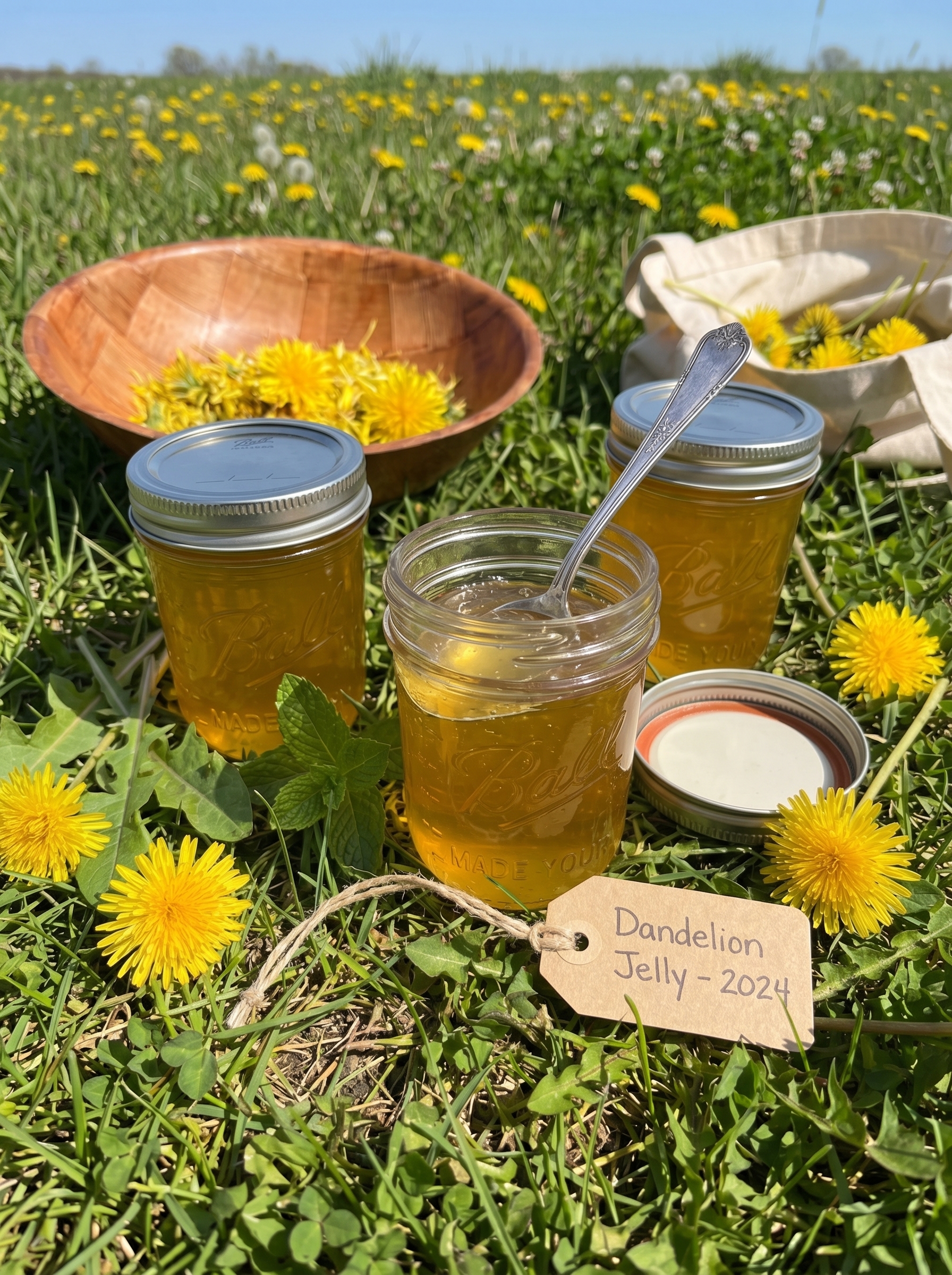
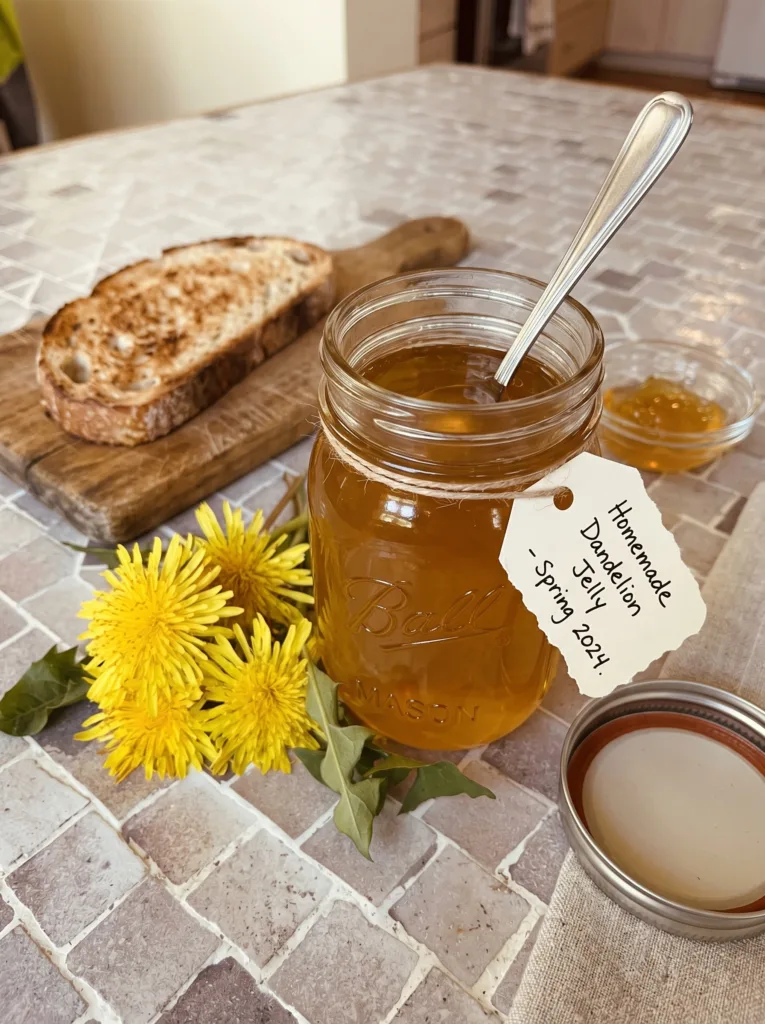
This best dandelion jelly recipe transforms the humble backyard “weed” into a jar of golden, jewel-like jelly with a delicate honey-floral flavor that tastes unmistakably like spring. If you’ve never made dandelion jelly before, prepare to be completely charmed — the color is a beautiful warm gold, the flavor is light and subtly sweet with a gentle floral note, and the whole process starts with something most people have growing in their yard right now for free.
There is something genuinely magical about foraging your own ingredients. Every spring, when the first bright yellow dandelions pop up across the lawn, it’s the signal to grab a bag and head outside. This is one of those rare recipes that doubles as a family activity — kids absolutely love filling a bag with flowers, and there’s something wonderfully grounding about turning something so simple and wild into a jar of beautiful homemade jelly. My own family can collect enough dandelions in about 15 minutes, and the excitement of seeing those golden jars lined up on the counter makes every minute of petal-snipping worth it.
The flavor is hard to describe until you’ve tasted it. It’s not quite honey, not quite floral, not quite citrus — it’s something uniquely its own. Light, delicate, and sweet with just enough complexity to make people ask “what IS this?” when they spread it on their morning toast. It’s the kind of jelly that feels special precisely because it only exists for a few precious weeks each spring.
And despite how impressive it looks and sounds, dandelion jelly is genuinely beginner-friendly. You don’t need advanced canning skills or special equipment beyond a large pot and some jars. You can keep it simple by storing it in the fridge, or take it one step further with a water bath for shelf-stable jars that make beautiful homemade gifts.
Whether you’re an experienced home canner or trying jelly for the very first time, this recipe is the perfect place to start. Let’s turn those dandelions into something extraordinary. 🌼✨
PrintDandelion Jelly Recipe
Golden, floral, and delicately sweet — a beautiful seasonal jelly made from fresh dandelion petals. Beginner-friendly with both fridge and shelf-stable storage options.
- Prep Time: 20 minutes active
- Cook Time: 15 minutes
- Total Time: 35 minutes
- Yield: 6 half-pint jars 1x
- Category: Condiment
- Cuisine: American
Ingredients
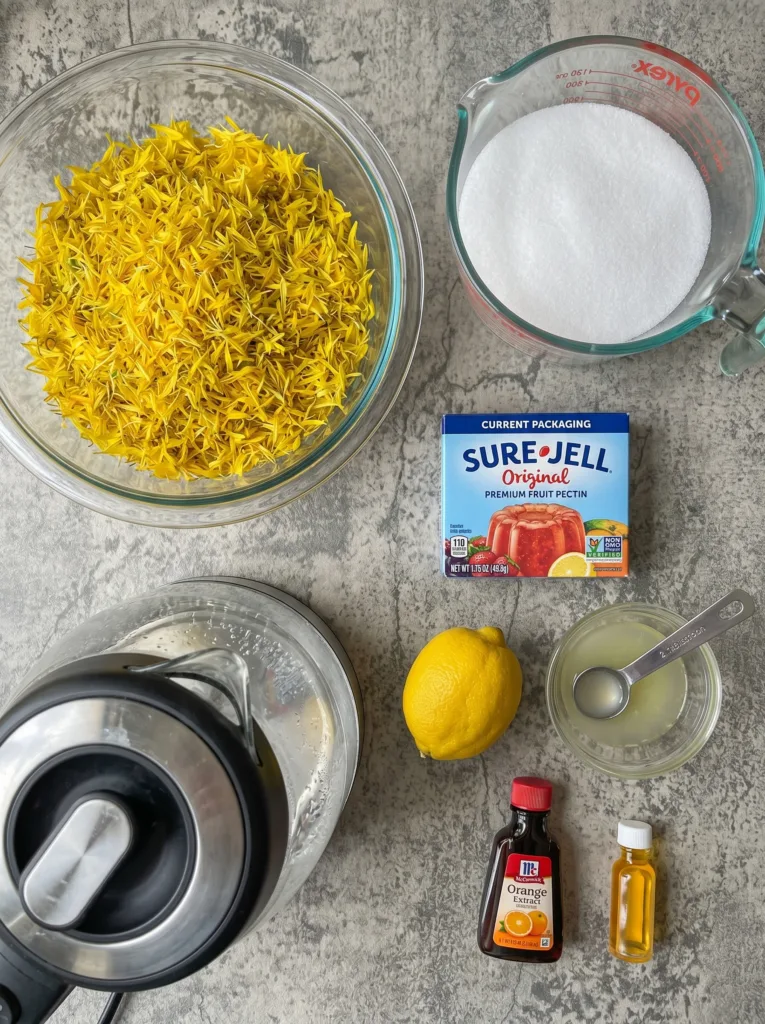
- 2–4 cups fresh dandelion petals (yellow only, green base removed)
- 4 cups boiling water (cold steep method) OR 2 quarts water (quick boil method)
- 2 tablespoons lemon juice
- 1 package powdered pectin (1.75 oz / 6 tablespoons — Sure-Jell Original recommended)
- 4–5½ cups sugar
- 1 drop yellow food dye (optional)
- 1 teaspoon orange extract (optional)
Instructions
Make the Dandelion Tea:
Cold Steep Method (recommended): Place 2–4 cups of separated yellow petals in a heatproof bowl. Pour 4 cups of boiling water over petals. Cover and steep in the refrigerator for 24 hours. Strain through a fine mesh strainer or coffee filter, pressing petals to extract all liquid. Measure 3–4 cups of tea.
Quick Boil Method (same day): Place petals and 2 quarts water in a large pot. Boil gently for 3 minutes. Cool completely. Strain and measure 3 cups of tea.
Cook the Jelly:
- Pour measured dandelion tea into your deepest large pot. Add lemon juice and powdered pectin. Stir well to dissolve pectin completely.
- Bring to a full rolling boil over medium-high heat, stirring frequently.
- Add all the sugar at once and stir vigorously. Return to a full rolling boil and boil hard for 1–2½ minutes, stirring constantly.
- Remove from heat. Skim off any white foam from the surface. Stir in yellow food dye and orange extract if using.
Fridge Storage: Ladle into clean jars. Cool to room temperature then refrigerate. Keeps up to 1 month.
Water Bath Canning: Ladle into hot sterilized half-pint jars leaving ¼ inch headspace. Remove air bubbles. Wipe rims clean. Screw lids finger-tight. Process in boiling water bath for 10 minutes (15 minutes above 6,000 ft elevation). Remove and rest undisturbed 24 hours. Shelf stable for many months.
Notes
- Use powdered pectin ONLY — not instant or liquid pectin.
- Murky tea is normal — color brightens when lemon juice is added.
- Jelly sets as it cools — allow 24–48 hours before deciding it hasn’t set.
- Do not double the batch — make two separate batches for larger quantities.
- Petals can be frozen for later use if needed.
Nutrition
- Serving Size: 1 tablespoon
- Calories: 45 kcal
- Sugar: 11 g
- Sodium: 1 mg
- Carbohydrates: 11 g
Why You’ll Love This Dandelion Jelly Recipe
- Unique seasonal treat — available only for a few precious weeks each spring, which makes every jar feel special and worth savoring.
- Delicate honey-floral flavor — light, golden, and subtly sweet with a gentle floral note that’s completely unlike any store-bought jelly.
- Fun foraging activity with kids — collecting dandelions together is genuinely enjoyable and gives little ones a real connection to where food comes from.
- Beginner-friendly — no advanced canning skills required. Fridge storage keeps it simple; water bath canning makes it shelf-stable for gifts.
- Beautiful homemade gift — a jewel-toned jar of golden dandelion jelly tied with ribbon is one of the most thoughtful and unique gifts you can give.
- Two storage options — refrigerate for up to a month or water bath can for months of shelf-stable enjoyment.
- Made from something free — dandelions grow everywhere and cost nothing, making this one of the most satisfying and budget-friendly recipes you’ll ever make.
Ingredients for Dandelion Jelly
Only a handful of simple ingredients stand between you and a jar of golden, floral dandelion jelly — but each one plays a specific and important role.
Key Ingredients Overview
The star of the show is of course the dandelion petals themselves. You’ll need 2–4 cups of bright yellow petals, carefully separated from their green base. The petals are steeped in hot water to create a golden dandelion tea that becomes the flavor and color foundation of the entire jelly. More petals mean a stronger, deeper flavor and richer color — but even 2 cups produces a beautiful, delicate result.
Water is what transforms those petals into usable tea. Two to four cups of boiling water poured over the petals (or a full 2 quarts if using the quick boil method) extracts the color and subtle floral flavor from the dandelions efficiently and gently.
Lemon juice does two important jobs. First, it brightens the color of the tea dramatically — you’ll notice the liquid shift from murky brownish-gold to a cleaner, warmer yellow the moment the lemon goes in. Second, it balances the sweetness of the sugar and adds a subtle tartness that keeps the jelly from tasting flat or one-dimensional.
Powdered pectin is the setting agent that turns your sweetened dandelion tea into actual jelly rather than syrup. It must be added at the beginning of cooking, before the sugar, to activate correctly. One standard 1.75 oz box — which measures out to about 6 tablespoons — is the right amount for this recipe.
Sugar provides the sweetness, body, and preservation power that makes this jelly work. The standard amount is 4–5½ cups depending on your preferred sweetness level. It goes in all at once after the pectin mixture reaches a boil.
Optional extras: A single drop of yellow food dye deepens the golden color for a more vibrant, jewel-like appearance — especially helpful if your tea came out lighter than expected. A teaspoon of orange extract adds a subtle fruity warmth that complements the floral flavor beautifully without overpowering it. Both are completely optional and the jelly is wonderful without them.
Ingredient Notes & Substitutions
- Powdered pectin ONLY — This recipe requires powdered pectin specifically. Do NOT substitute instant pectin (designed only for no-cook freezer jams) or liquid pectin (behaves completely differently and requires different quantities and timing). Using the wrong type is the number one reason dandelion jelly fails to set. Stick with powdered pectin — Sure-Jell Original 1.75 oz is the most widely available and reliable choice.
- Pectin amount — Use one 1.75 oz box or 6 tablespoons if measuring from a bulk container. Different brands vary so always check the label and use the powdered original version, not low-sugar or no-sugar varieties unless you adjust the entire recipe accordingly.
- Sugar substitutes — Replacing sugar requires using a no-sugar or low-sugar specific pectin as regular powdered pectin needs sugar to set properly. Artificial sweeteners may also reduce shelf life so additional research is recommended before substituting.
- Honey instead of sugar — You can substitute honey using a ratio of ⅞ cup honey per 1 cup sugar. The flavor will be richer and more pronounced — pair beautifully with the floral dandelion base. Note this will affect the final color and slightly change the set texture.
- Yellow food dye — Completely optional. One drop is enough to give the jelly that vivid golden color. Skip it for a completely natural version — the jelly will still be beautiful, just a softer honey tone.
- Orange extract — Optional but lovely. Use exactly 1 teaspoon for a subtle fruity note. Leave it out entirely if you want the purest, most delicate dandelion flavor to shine through.
Recipe Success Tips
These tips come directly from tested experience and real reader troubleshooting — follow them and your jelly will set beautifully on the first try:
- Harvest on a dry day away from pesticides and roads — Wet or muddy flowers make petal separation messy and can affect flavor. Always gather from areas you’re confident are free from spraying, heavy foot traffic, and roadside exhaust. Clean flowers mean clean-tasting jelly.
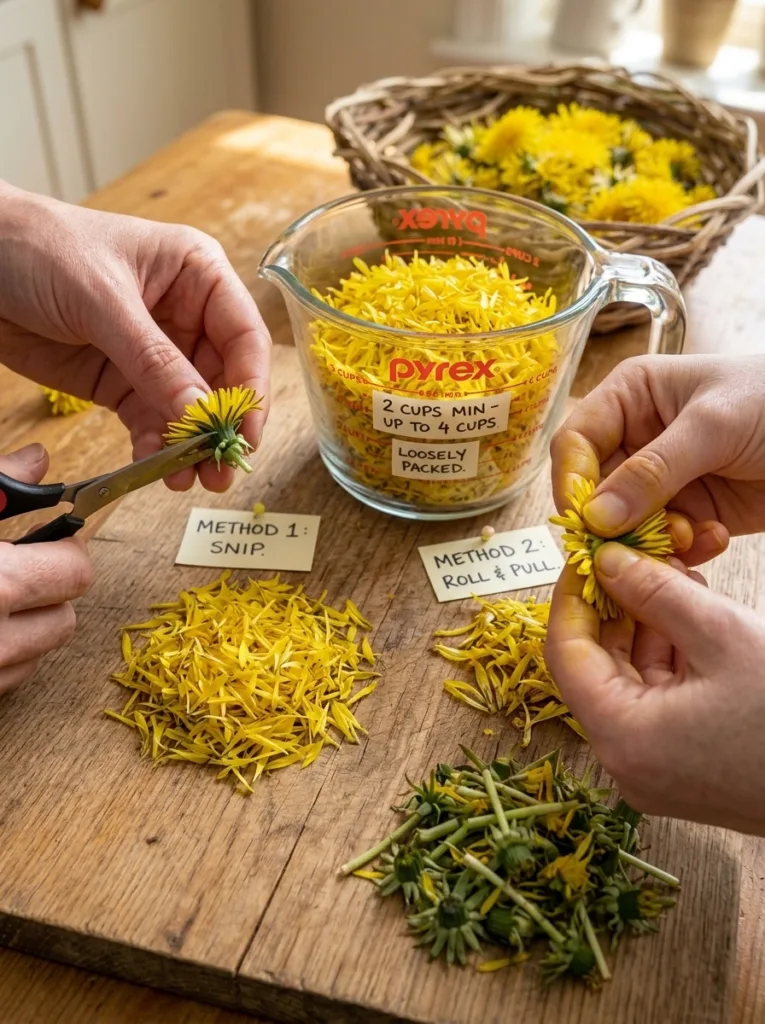
- Remove ALL the green parts — The green base and stem of the dandelion flower is bitter and will negatively affect the flavor of your jelly. Take your time separating yellow petals only. Grasp the flower by the petal end and snip the stem and green base off cleanly with scissors, then pull the yellow petals free.
- Make your tea promptly after picking — Dandelion petals are at their most vibrant and flavorful right after harvesting. Make your tea the same day if possible while the petals are still bright yellow. If you can’t, freeze the petals — they freeze well and can be used later without significant flavor loss.
- Murky tea is completely normal — After steeping or boiling, your dandelion tea may look cloudy, brownish, or slightly greenish. This is perfectly fine. The moment you add lemon juice, the color brightens noticeably. If you want extra clarity, strain the tea through a coffee filter before cooking.
- Powdered pectin is non-negotiable — Using the wrong type of pectin is the single most common reason dandelion jelly doesn’t set. Instant pectin and liquid pectin are not interchangeable with powdered pectin in this recipe. Always use standard powdered pectin and add it before the sugar.
- Maintain a full rolling boil after adding sugar — A rolling boil is one that cannot be stirred down. After adding the sugar, boil hard for the full 1–2½ minutes (depending on your method) while stirring constantly. Under-boiling is the second most common cause of jelly that stays liquid.
- Use your deepest pot — Jelly boils up dramatically when it reaches a rolling boil and can overflow a shallow pot quickly. Use the deepest pot you own to avoid a dangerous, sticky mess on your stove.
- Don’t panic if it seems loose when hot — Jelly sets as it cools, not while it’s still hot. If your jelly looks thin when you ladle it into jars, give it 24–48 hours before worrying. Refrigerated jars set faster than water-bath-canned jars, which may take a day or two longer to reach their final consistency.
- Test for gel before jarring — Place a metal spoon in the freezer for 1–2 hours before you start cooking. When your jelly has boiled for the full time, dip the frozen spoon into the hot jelly and lift it above the pot. Tilt the spoon so the jelly runs off the side — if it forms two drops that flow together and fall off in a single sheet, your jelly is ready to jar. If it drips off in thin separate drops, boil for another 30–60 seconds and test again.
- If you prefer a deeper golden color without artificial food dye, add a small pinch of turmeric powder to the tea before cooking. It brightens the color naturally without affecting the flavor at all.
How to Make Dandelion Jelly Step-by-Step
Making dandelion jelly is a rewarding process that unfolds in clear, manageable stages. Most of the time is hands-off — steeping, cooling, or waiting for jars to seal. Here’s exactly how to do it from first petal to finished jar.
Harvest and Prepare the Dandelion Petals
Head outside on a dry day and gather your dandelion flowers — you’ll need enough to yield 2–4 cups of yellow petals. Pick bright, fully open blooms and avoid any that look wilted, muddy, or past their prime. Stay away from roadsides, areas that may have been sprayed with pesticides, or spots with heavy animal traffic. A clean picking location means clean, pure-tasting jelly.
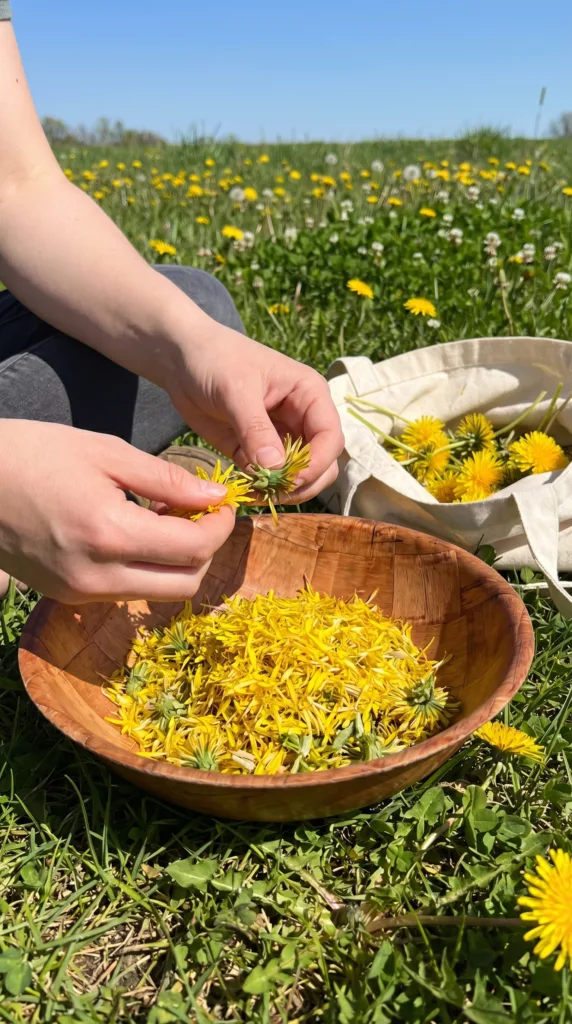
Once home, it’s time for the most time-consuming part of the whole recipe — separating the yellow petals from the bitter green base. There are two ways to do this. The first method is to hold each flower by the petal end and snip straight across just above the green base with scissors — clean, tidy, and keeps your hands relatively unstained. The second method is to press the green base between your fingers and roll, loosening the petals so you can pull them free — messier but captures more petal including the pollen-rich base.
Either way works well. The key is removing as much green as possible since even small amounts of the green base will add bitterness to your finished jelly. A few tiny bits won’t ruin it, but be thorough. Work at your own pace — put on a podcast, a baseball game, or just enjoy the meditative rhythm of it.
Measure your separated petals loosely into a bowl or measuring cup. You need a minimum of 2 cups and up to 4 cups — you don’t need to pack them down, just toss them in until you reach your measurement.
Make the Dandelion Tea
The dandelion tea is the flavor foundation of your jelly. There are two methods — choose based on your timeline and how deep a flavor you want.
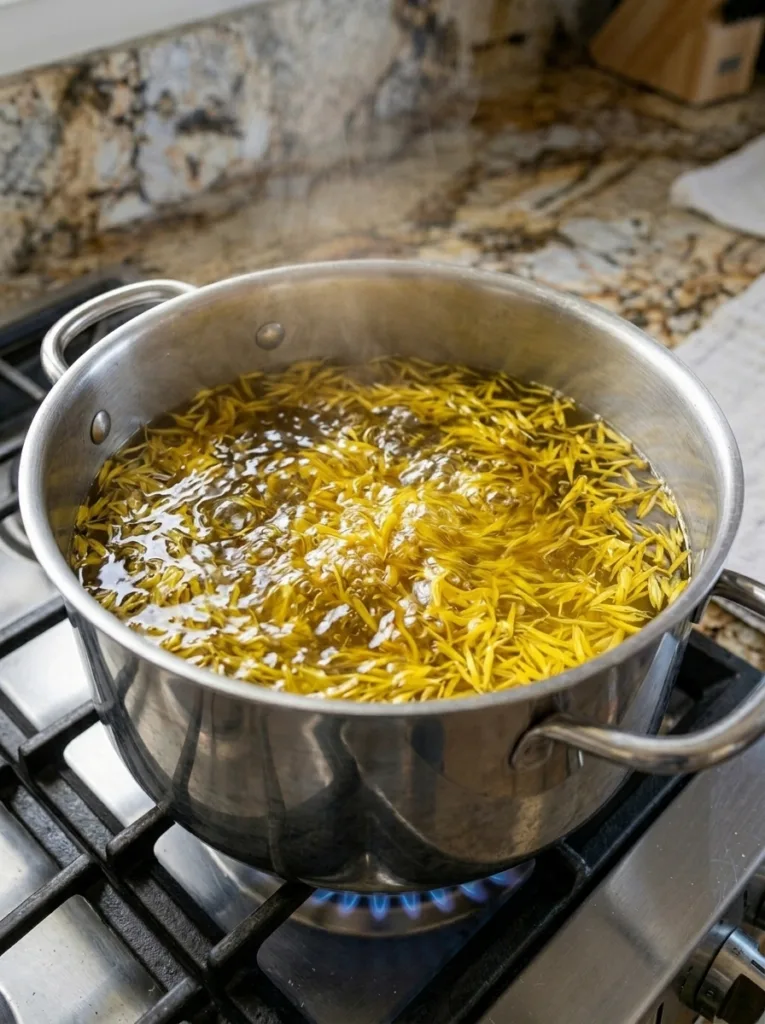
Method 1 — Quick Boil (same day): Place your 2–4 cups of petals in a large pot with 2 quarts (8 cups) of water. Bring to a boil and boil gently for 3 minutes. Remove from heat and allow to cool completely — this can take several hours. Don’t rush the cooling; a longer cool time actually develops the deepest possible color in your finished jelly.
Method 2 — Cold Steep (deeper flavor, 24 hours): Place your petals in a large heatproof bowl or jar. Pour 4 cups of boiling water directly over the petals. Cover loosely and steep for a few hours or preferably overnight. You can leave it at room temperature or place it in the refrigerator — both work perfectly well. Room temperature steeping is fine as long as your kitchen isn’t extremely warm.. This slower extraction produces a more concentrated, nuanced flavor. If you need to wait longer — say 48 hours because life got in the way — simply strain the petals out and keep the liquid refrigerated until you’re ready to cook.
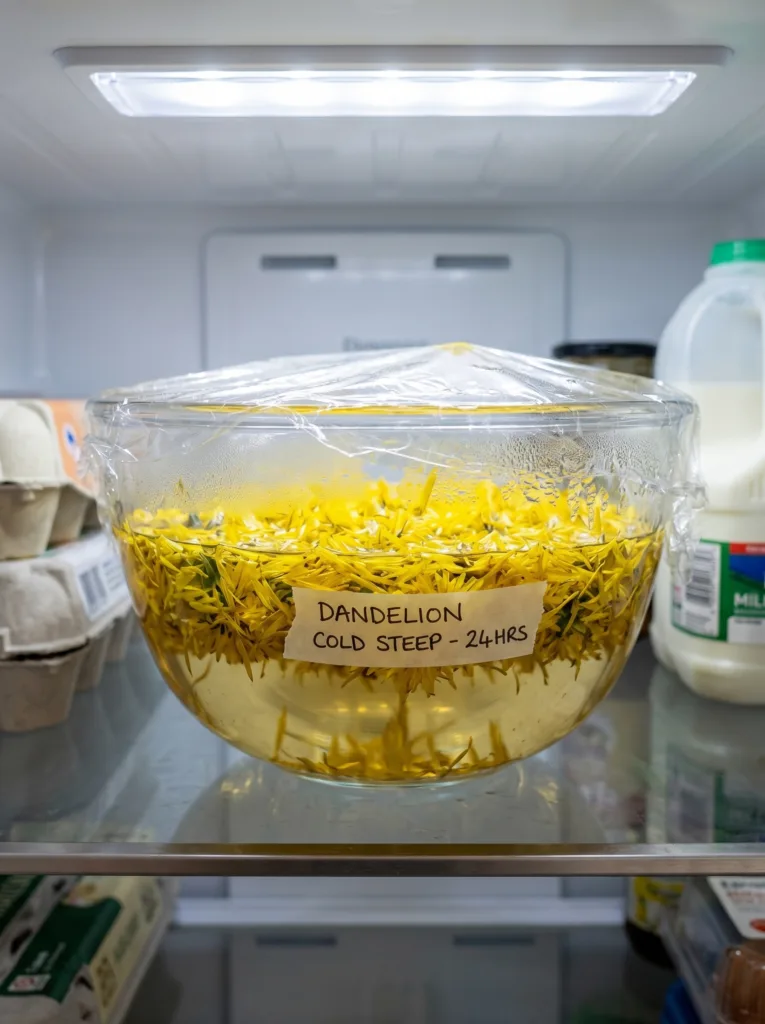
Both methods produce beautiful jelly. The cold steep gives a slightly more complex flavor; the quick boil is faster and still delicious. Use whichever fits your schedule.
Strain and Measure the Tea
Once your tea has finished steeping or cooling, it’s time to strain out the petals and collect your liquid.
Pour the tea through a fine mesh strainer lined with a paper towel or coffee filter set over a large bowl. Let gravity do most of the work first, then gently press or squeeze the petals to extract as much liquid as possible. Some people wring the petals out by hand for maximum yield — this is perfectly fine and gets you every last drop of that golden liquid.
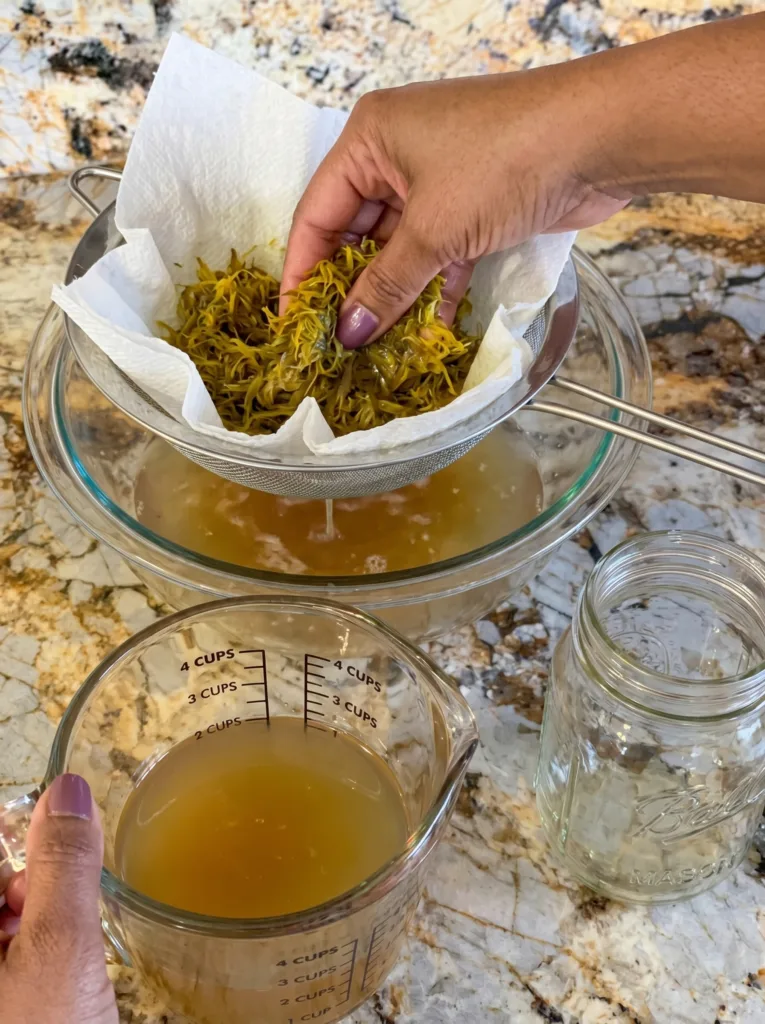
Your strained tea may look murky, slightly cloudy, brownish, or even a little greenish at this stage. This is completely normal and not a sign anything went wrong. The color transforms beautifully once lemon juice is added in the next step.
Measure out exactly 3–4 cups of dandelion tea for the recipe. If you end up with slightly more or less, that’s fine — the important thing is having at least 3 cups of good strong tea to work with.
Cook the Jelly
Now the transformation happens — this is where your golden tea becomes actual jelly.
Pour your measured dandelion tea into your deepest large pot. Add the lemon juice and watch the color brighten immediately — this is the lemon doing its job, both clarifying the color and balancing the sweetness. Add the powdered pectin and whisk or stir well to combine. Make sure the pectin is fully dissolved before applying heat.
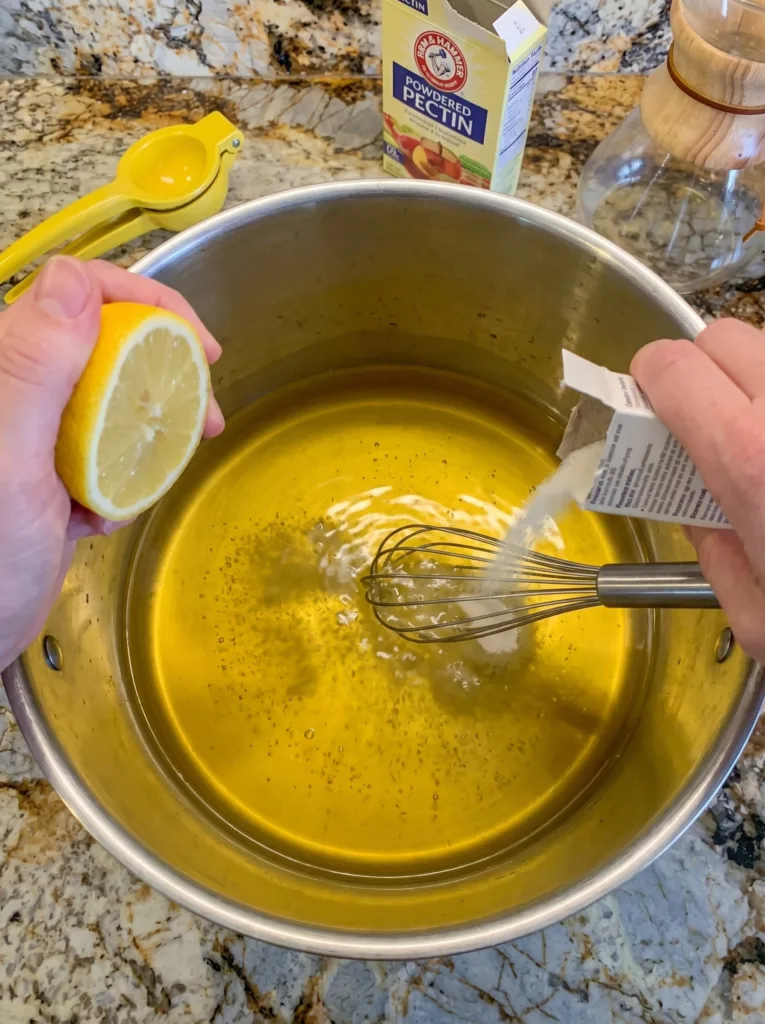
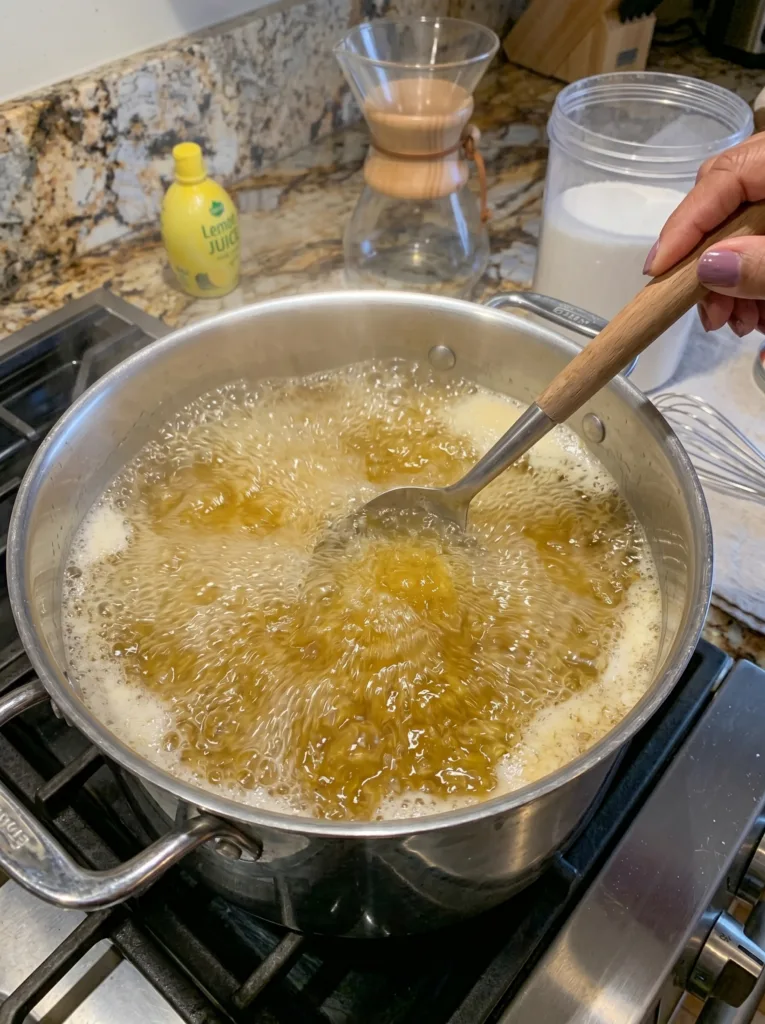
Bring the mixture to a full rolling boil over medium-high heat — stirring frequently. A rolling boil is one that cannot be stirred down, with large, active bubbles churning across the entire surface. Once you reach a true rolling boil, add all the sugar at once and stir vigorously to dissolve.
Return the mixture to a full rolling boil and boil hard for 1–2½ minutes (1–2 minutes for the steep method, up to 2½ minutes for the quick boil method) while stirring constantly. Watch the pot carefully — the jelly will rise dramatically in the pot during this boil. This is exactly why you need your deepest pot. Don’t leave the stove during this stage.
After boiling, remove the pot from heat. Use a large spoon to skim off any white foam or “gunk” that has risen to the surface — this is just air and harmless but removing it gives you a clearer, prettier jelly. If using yellow food dye or orange extract, stir them in now.
Fill the Jars and Store
With your jelly cooked and skimmed, it’s time to get it into jars. Work quickly — the jelly begins to set as it cools.
Fridge Storage Method (simplest): Ladle the hot jelly directly into clean glass jars using a wide-mouth funnel. Fill to about ¼ inch from the top. Wipe the rims clean, screw on the lids, and allow to cool to room temperature before refrigerating. The jelly will set within a few hours to overnight in the fridge. Refrigerated dandelion jelly keeps well for up to one month. This is the perfect method if you’re keeping most jars for yourself or giving them as gifts to be used soon.
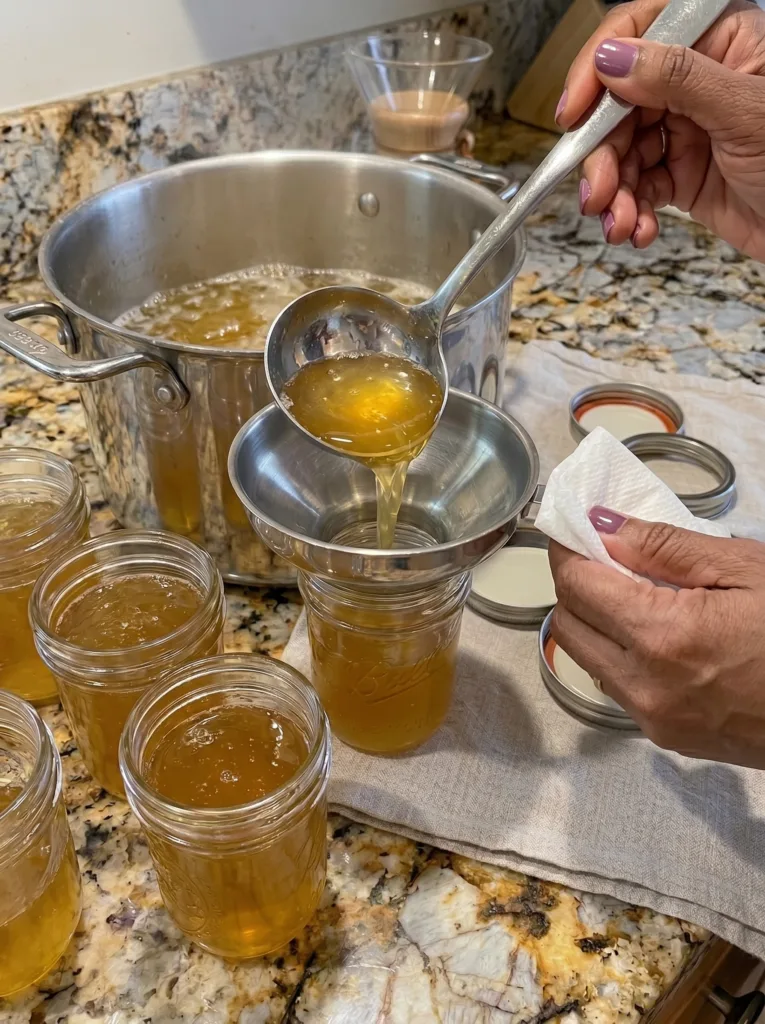
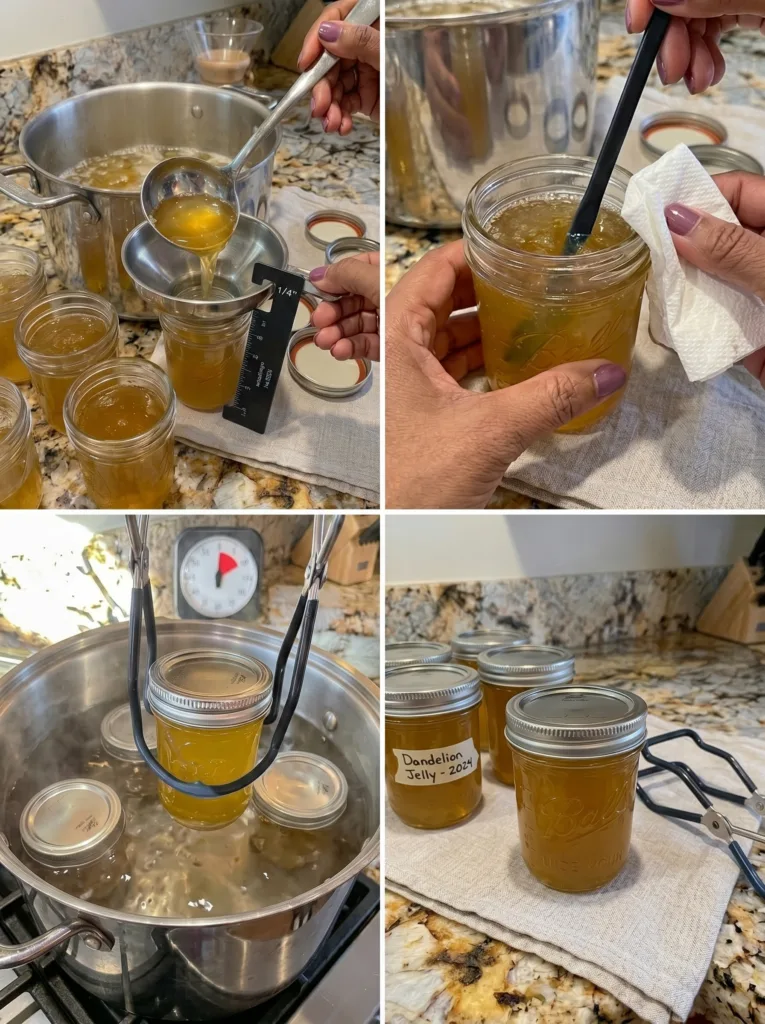
Water Bath Canning Method (shelf-stable): For long-term storage, ladle hot jelly into hot sterilized half-pint jars leaving exactly ¼ inch of headspace. Run a clean knife or canning spatula around the inside edge of each jar to release any air bubbles. Wipe jar rims with a clean cloth or white vinegar-dampened paper towel to ensure a good seal. Screw lids on finger-tight — not too loose, not overtightened. Process in a boiling water bath canner for 10 minutes (15 minutes if you are above 6,000 feet elevation). Remove jars with canning tongs and place on a towel in a draft-free area. Leave completely undisturbed for 24 hours. You should hear the satisfying “pop” of each lid sealing as they cool. Properly sealed, water-bath-canned dandelion jelly is shelf stable for many months.
Flavor Variations
Once you’ve mastered the base recipe, these simple twists make each batch uniquely yours:
- Orange extract version — Add 1 teaspoon of orange extract after removing from heat for a subtle fruity warmth that complements the floral dandelion flavor beautifully without overpowering it.
- Honey instead of sugar — Substitute ⅞ cup of honey per every 1 cup of sugar called for. The result is a richer, more complex sweetness that pairs naturally with the floral notes. Use no-sugar pectin when making this swap.
- Vanilla touch — Stir in ½ teaspoon of pure vanilla extract at the end of cooking for a warm, rounded sweetness that makes the jelly taste almost like a delicate dessert spread.
- Lemon zest boost — Add 1 teaspoon of fresh lemon zest along with the lemon juice for a brighter, more citrus-forward flavor that cuts through the sweetness with a lovely fresh note.
- Color options — Skip the yellow food dye for a natural honey-gold tone, or add one single drop of yellow dye for a more vibrant, jewel-like golden color. Both are beautiful — it’s purely personal preference.
Serving Suggestions
Dandelion jelly is delicate and versatile — here are the best ways to enjoy it:
- On toast or English muffins — The classic. That golden jelly melting into warm buttered toast is pure spring morning perfection.
- On scones or waffles — The floral sweetness pairs beautifully with buttery baked goods and makes any breakfast feel special.
- Between cake layers — Spread between vanilla or lemon cake layers for a unique, lightly floral filling that surprises and delights with every slice.
- On a cheese board — Serve alongside soft brie, creamy goat cheese, or sharp cheddar. The delicate sweetness balances savory cheese beautifully.
- As a homemade gift — A small jar tied with ribbon and a handwritten label is one of the most thoughtful and unique gifts you can give — especially paired with a fresh loaf of sourdough bread.
Storage Instructions
Refrigerator storage: Ladle into clean jars, cool to room temperature, then refrigerate immediately. Keeps well for up to 1 month in the fridge. The jelly may take several hours to overnight to fully set after refrigerating — don’t worry if it looks loose at first.
Water bath canned (shelf-stable): Properly processed and sealed jars keep for many months stored in a cool, dark place. Once a jar is opened, refrigerate immediately and use within a few weeks.
Extended steeping note: If your tea has steeped longer than 24 hours, strain out the petals and keep the liquid refrigerated until ready to use. Up to 48 hours is fine — beyond that the flavor may change slightly.
Food safety note: Always use clean sterilized jars. Never leave finished jelly at room temperature for extended periods. If a water-bath-canned lid does not seal properly (lid flexes up and down when pressed), refrigerate that jar immediately and use within one month rather than storing at room temperature.
FAQ About Dandelion Jelly
My jelly didn’t set — what went wrong?
The most common causes are incorrect pectin type, not enough pectin, or not reaching a true full rolling boil after adding the sugar. Make sure you used standard powdered pectin — not instant or liquid — and that you boiled hard for the full 1–2½ minutes while stirring constantly. If your jelly is still liquid after 48 hours, you can attempt to reprocess it: return it to a pot, bring back to a boil, add a little more pectin dissolved in water, boil again, and re-jar. It won’t always be perfect but it’s worth trying before discarding the batch entirely.
My dandelion tea looks murky and cloudy — is that normal?
Completely normal and nothing to worry about. Dandelion tea is not a clear liquid — it will look somewhat murky, brownish, or even slightly greenish after steeping or boiling. The moment you add lemon juice during cooking, the color brightens noticeably. If you want extra clarity, pour the tea through a coffee filter before cooking — this removes fine sediment and gives a cleaner final color without affecting the flavor.
Can I freeze dandelion petals to use later?
Yes — dandelion petals freeze surprisingly well. If you find dandelions blooming but aren’t ready to make jelly yet, simply separate the yellow petals from the green base, spread them on a tray to freeze individually, then transfer to a freezer bag. Use within a few months for best flavor and color. This is also a great solution if you want to collect petals gradually over several days until you have enough for a full batch.
Can I steep the petals for longer than 24 hours?
Up to 48 hours is generally fine — life happens and an extra day won’t ruin your tea. Beyond 48 hours the flavor can start to change and the color may oxidize and turn darker or more honey-toned rather than bright golden yellow. If you need more time before cooking, strain the petals out after 24 hours and simply store the liquid refrigerated until you’re ready to proceed.
Can I use instant pectin instead of powdered pectin?
No — instant pectin is not interchangeable with powdered pectin in this recipe. Instant pectin is specifically designed for no-cook freezer jams and jellies and does not work properly in cooked jelly recipes. Using it will result in jelly that does not set correctly. Always use standard powdered pectin — Sure-Jell Original 1.75 oz is the most reliable and widely available choice.
Can I use liquid pectin instead of powdered?
Liquid and powdered pectin behave very differently and are not a direct substitute for each other. Liquid pectin is added at the end of cooking while powdered pectin is added at the beginning before the sugar. The quantities are also different. If you only have liquid pectin available, research the specific conversion for your brand before proceeding — a simple ounce-for-ounce swap will not give you the correct result and your jelly likely won’t set properly.
Can I use a sugar substitute in dandelion jelly?
It is possible but requires specific no-sugar or low-sugar pectin to work correctly — regular powdered pectin needs a certain amount of sugar to activate and set properly. The type of substitute also matters: some artificial sweeteners reduce shelf life, others affect texture or flavor significantly. If you want to reduce sugar, research your specific substitute and pair it with a no-sugar pectin designed for that purpose. The flavor and texture of the finished jelly will be different from the original.
Can I use honey instead of sugar?
Yes — substitute ⅞ cup of honey for every 1 cup of sugar the recipe calls for. Honey produces a richer, more complex sweetness with a slightly different flavor profile that actually complements the floral dandelion notes beautifully. Keep in mind that honey will affect the final color — making it slightly darker and more amber — and may produce a slightly softer set. Use no-sugar pectin when making this substitution for best results.
My jelly came out honey-colored instead of bright yellow — did I do something wrong?
Not necessarily — this is usually caused by oxidation from steeping the tea longer than 24 hours or allowing it to sit before cooking. The color can also naturally vary depending on how much green made it into the tea and how vigorously you boiled it. The jelly is still perfectly safe and delicious to eat — the flavor is not affected by a slightly darker color. If bright golden color is important to you, add one drop of yellow food dye at the end of cooking. Next time, make the tea and cook the jelly within 24 hours for the most vibrant color.
How long does dandelion jelly keep?
Refrigerator-stored jelly (unsealed jars) keeps for up to one month. Water-bath-canned sealed jars are shelf stable for many months stored in a cool dark place. Once any jar is opened — whether previously canned or not — refrigerate it immediately and use within a few weeks for best quality and safety.
Can I double the batch?
It is generally not recommended to double jelly recipes. Larger quantities of liquid take longer to reach the necessary rolling boil temperature, which can interfere with how the pectin sets and result in soft or liquid jelly. If you want to make more, make two separate batches back to back rather than doubling in one pot. This gives you consistent, reliable results every time.
Is it safe to eat dandelions?
Yes — dandelions are completely edible and have been eaten and used medicinally for centuries. They are an excellent source of vitamins A, C, and K and contain beneficial antioxidants and anti-inflammatory compounds. The key is harvesting from areas you are confident are free from pesticides, herbicides, and heavy animal traffic. Never gather from roadsides with heavy exhaust exposure. When harvested from a clean environment, dandelions are a safe, nutritious, and delicious ingredient.
Final Thoughts
Dandelion jelly is one of those recipes that reminds you how much magic is hiding in the most ordinary places — a backyard full of “weeds” becomes jars of golden, floral sweetness that taste like spring in every spoonful. Make a batch this season, share a jar with someone you love, and tag @savorgastronomy with your beautiful golden jars — I want to see every single one! 🌼✨